Saturday, December 17, 2005

Nearly Stow-on-the-Wold


It was not exactly Stow-on-the-Wold, but nearer towards Bledington, where we stopped for the night after spending the last six nights in Cambridge. My fever was subsiding but everything else to do with the flu symptoms was getting bad. And I was very glad that the Bed and Breakfast Farmhouse that we stayed at the Cotswold was very comfortable.

It was almost dark as we drived slowly on to the gravelled driveway, as the picture above suggest. The winter nights get dark quickly, even at 3:30 pm.

The B&B is managed by Robert Smith and his partner, and the farm is managed by Robert's brother. The farm does not have animals (what a shame, I was looking to make friends with some chickens, cows and even, pigs!) as the farm was solely used to grow produce to feed animals, such as hay and barley. I thought that living in the countryside would be very cold as the temperature was dipping freezing point, but the room was very warm, and I was looking forward to visiting Cirencester the next day, after getting a good rest.

Dinner was at a locally famous but pricey pub (as there are no other places near enough to go, and it gets very dark and dangerous to drive on the unlit country roads and wintry night conditions), but it had a huge fire-place with logs burning, like an open hearth, right in the middle of the dining area. The pub is called the Horse and Groom, and it is half a mile towards Lower Oddington.

Here are some pics to share:

The gravelled driveway approach to the B&B went around a bend along the farm buildings, hay stack loft and hangar-like barn sheds, and farm vehicles.

One of the buildings on the farm, which I don't think is a part of the B&B. Probably Robert's brother, the farmer's house...

We can see part of the B&B from across the field. I bet it's really lovely in the summer, spring or autumn weather, but not when we were there! Just our luck.

The hay stack loft covered by tarpaulin and the blue farming vehicle parked next to it. Proof that we stayed at a farm!

Firewood/firelogs were chopped from felled trees/ tree branches collected around the farm or perhaps from a productive forest reserve nearby, but no, we did not have any firewood! Just the usual central heating radiators. Well, I am glad in a sense, because I would be gagging with my stuffed up nose with the extra smoke particles in the room... cough*

Well, that is I, holding a wooden rake at the front of the section of the B&B, where I stayed for the night. The window nearest to me was my bedroom window.

That is I, again, looking pleased with myself, that I have managed to get to the Cotswold, and now we are off to Cirencester and South Wales next, but I was worried about the fog though...and I discovered later that it was difficult driving through the fog. Not nice at all...

Last but definitely, not least, the picture of the co-driver (not very clear it seems) and the sunset beyond the farm... how poetic!

See you in Wales!

Wednesday, December 14, 2005

The Tourist Gaze

Gazing at the scenery that passed me by as I sat in the Cambridge train to King's Cross, I reflected on the previous days events. The smell of recently dugged out fields mixed with manure stung my senses. I cringed slightly. I thought that people are made of all shapes and sizes. I thought about what Alain de Botton said about "art".

I am going to use that take-away plastic cup in the train and use it at the guest room at Trinity Hall. "The Art of Travel" was the name of the book. De Botton's writing was caught at many levels; the literal and direct level of suggestion and the philosophical discussions when he analysed historically what other people wrote about travel, especially from the writers of the 18th century. Why the 18th century? The love of travel came about from explorers from that century and earlier on, as then it was pure madness to travel 5,000 miles away and get killed in the process! De Botton used a lot of their publication and paintings of these other world.

I read the "Tourist Gaze" earlier, at that time in 1995-96 at the DPU in London. I did a seminar paper on Tourism and Development and the papers that I read were of the highest quality. The tutor gave us a stack of papers to read and to use for our seminars and dissertation.

We try to fight for our individual space. To be free from information overload. We keep on seeing and grasping new things, objects, sceneries, experiences, words, pieces of information and everything seems relevant!

Processes...basic physiological and biological processes for one! Like our sight process, our hearing process, our walking process, building process, development process... (At that point I veered off from the subject of travel, and made a diagram relevant to my thesis...)

Am I an accidental tourist? Caught by chance with vignettes of travel treats. I think I am living here in the UK, but at the same time, I am a tourist. A tourist at TESCO, a tourist of Salford, a tourist at Sedgeley Park Little Laundrette...because I possess the "Tourist Gaze", a slightly bemused feeling that all this I am living is temporary and I will be in Malaysia in December next year... processes.

Tuesday, December 13, 2005

You'll Never Walk Alone


The photo above was taken at Anfield last year in August.
So a year and a bit later, Liverpool FC's is in Japan ready to challenge for the World Club Championship Winner's Cup. Good Luck guys!
Here's a good write up on that: First the World Then the Prem.

Below is a photo (taken from redandwhitekop.com message boards) of the coveted trophy.


In order to win this trophy and the winner's medal LFC needs to be really charged up, so here's the song to do it.

You'll Never Walk Alone is the emotionally-charged football chant that the Kop sings to get players into the mood, with the desire to go against all odds. Liverpool will surely need it to get them going.

Gerrin' there you Redmen!

Lyrics to:
You'll Never Walk Alone
Gerry and the Pacemakers
(R. Rodgers - O. Hammerstein II)

When you walk through the storm
Hold your head up high
And don't be afraid of the dark
At the end of the storm
There's a golden sky
And the sweet silver song of the lark

Walk on, through the wind
Walk on, through the rain
Though your dreams be tossed and blown
Walk on, walk on, with hope in your heart
And you'll never walk alone
You'll never walk alone

Walk on, walk on, with hope in your heart
And you'll never walk alone
You'll never walk alone

(Lyrics taken from: http://www.songlyrics.com/showsongp.php?id=37859)

Friday, December 09, 2005

Liverpool Football Fanatic


I am a Liverpool Football Fanatic.

I love the club. I have supported it since the Dalglish days in the 80s. My late father who went to study at Kirkby Teacher's Training College in the early 60s supported Everton, but he did not influence his children on their choice of teams.

Like many Malaysians, we followed the English leagues avidly since the 70s.

My two brothers had a lot of those Match magazines around, and I decided to read them too. In the 70s, I watched a lot of Leeds United game on Malaysian television, but in the 80s, Kenny Dalglish, Peter Beardsley, Alan Hansen, John Barnes were right up there as the best footballers in the English leagues. One of my brothers and I decided then to follow Liverpool FC. And the youngest brother decided on Arsenal because he liked the name and he wanted to rile us up. Well, Liam Brady was the Arsenal star at that time when he was growing up.

Currently, Liverpool is making waves again. They topped their group in the UEFA Champions League campaign beating Chelsea to head the group. They had not lost in the last 14 CL matches so far. Is it possible for them to win it again the 6th time in Paris next year? They would need to beat many top teams in Europe again to do so.

I remembered going to Anfield to two of last season's matches last year, one against Deportivo La Coruna and the other against Bayer Leverkeusen. It was tough for them to qualify to the knock out round, and they had to get in a last minute goal by Steven Gerrard to beat Olympiakos to get through the group stages. And now they had managed to get through the group stages relatively easy and topping it above Chelsea as well.

I never thought Liverpool was going to be champions last May. But they did. And what a final that was against AC Milan. 3-0 down and they managed to win finally with 4-3 on penalties. It was an amazing night. I called my brother in Malaysia, at that time it was 4 am in Malaysia, and he said he cried. I cried too. Liverpool's two Malaysian fans crying their heart out for their favourite team in a telephone conversation 5,000 miles apart.

I took my mother and my brother and his family to visit Anfield last year in August. (Picture above shows my nephew and I sitting on the bench in front of Alonso and Garcia's shirts in the player's changing room.) I think my brother and I was going on a "pilgrimage" to the football stadium and ground. We were so happy and we were absorbing everything. Yes, they do say that football is like a religion, and when you read comments and opinions in the football club's websites, you would think so, definitely.

(See liverpoolfc.tv) (See redandwhitekop.com)

Liverpool is starting to really work as a team, and they could provide a serious challenge to Chelsea even in the Premiership league. Well, we shall see. YNWA.

Monday, December 05, 2005

Networking is King

The way I see it, in Malaysia, when it comes to disability issues and the work needed to highlight and campaign for disabled people's rights, progress at moment will only come from volunteer and charitable organisations. For example, please read on the recent establishment of MIND, funded by BAKTI. Peter Tan had also highlighted this in his blog.

Being realistic, we are far away from the progress achieved by people in the UK, for example. For the last 10 years, significant progress had been made whereby the UK Government had taken the initiative to promote the rights of disabled people, by introducing the DDA and the Disability Discrimination Bill, as shown on the DRC website.

When will the Malaysian Government do the same?

People would argue that in Malaysia, we do things differently than in the UK. The sooner that we realise that this is not the case and never should be, the better. The fact remains that we are 20 to 30 years behind the UK in terms of work effort and results. We need to realise this so that the clearer we see the problems now and ahead of us, the better we are to plan ahead and prepare for the things that we need to be done. We should be in a position to forge ahead with our goals but we need to realise what they are first.

Disabled people have to start doing things for themselves, because that was what happened in the UK, US and all those countries that managed to get the results needed. Disabled people in the UK started to do those things in the 70s and by 1979 the first Building Regulation in the UK incorporating Access for Disabled People was enacted and established. In Malaysia, we had a similar building regulation done in the time period of 1991-1994. But the push for the rights of disabled people in the UK continued until 20 years later. So many achievements have been made that disabled people are now being sought after to be consultants and advisors to many projects throughout the country. I know so, because I had problems getting disabled people to be interviewed for my research as they are so busy being consulted upon. But never take it for granted that disabled people in the UK had it so easy. They had to fight for it. And in Malaysia, we are only starting to do it.

It is fine to quarrel about the accessible toilets and get caught with it all, but we need to get a bigger view of things. That is not to say to lay down low and not get our hands dirty with the arguments. But more importantly, to educate and learn about how to go about doing things, so that our arguments become sharper and filled with facts, ideas and solutions to problems.

One way is to be skillful in putting our arguments across. Another is knowing how to work together.

When I see MIND being organised and established, I know that it was not easy. I know personally the project leader and how she had to utilise whatever resources that she has at hand to create this project. There is only one full time staff, like in many other charitable and volunteer organisations in Malaysia, because that is the basic thing that this type of organisation need to have in order to sustain itself, but in order for it to move, the volunteer system is the crux of it all.

Another organisation that I salute in having it established and up and running is the SDPP.
Again I also know the leader personally and how hard he had worked at sustaining this organisation, despite being ill and set with a many adversities. The volunteer work in the SDPP is also excellent and had gotten many results. I had highlighted their work in my earlier blog postings.

Often the leader needs someone to push them with their efforts. All the talent and hardwork should never be under-estimated.

These volunteer and charitable organisations and many others in Malaysia, need to be stronger and get excellent networking opportunities for everyone concern with issues on disability. Through this network, we will be able to gain more knowledge and understanding of what is needed to be done, how to do it and most of all, we will not be alone in doing our work.

Networking is king!

We should start somewhere and move on.

Friday, December 02, 2005

Cirencester Part Two - Corinium Museum

After visiting the Parish Church, we walked to the Corinium Museum about 300 meters away. With funding from Heritage Lottery Fund and the Cotswold District Council, the museum had undergone a major refurbishment for two years and had just re-opened in June 2005.


The photo above shown with the courtesy of www.ukattraction.com, is the main entrance to the museum, through the Ionic columned portico. The Corinium Museum, Cirencester did not feel like an imposing building, and appeared hidden away, especially for the first time visitor. I noticed a sign protruding out from the facade as I walked on that street, and that was how I knew it was there. Although it was Saturday, not many people were visiting the museum, and we had it all to ourselves.


One of the exhibits that I found to be interesting was the "Talking Gravestones". These were gravestones found from Roman times, where "stories can be heard" about the "dead person" from whichever gravestone that you click on the interactive board in front. You can tell that the designer wanted children to enjoy the exhibits, and it is such a fantastic idea.

Obviously, when they redesigned the museum, they had extensive consultations with the users, including disabled people. You can have a good assumption on this because the displays have been designed for clarity and contrast between the letterings and the background using the correct font sizes.

There were many mosaic pieces preserved from the Roman times, and this particular display shows floor tiles from a Roman villa, and the information boards were placed at the correct height for children and wheelchair-users. Children are able to squat or bend down and have a better look at the mosaic pieces.


All the displays, to me, had been accessible for children and wheelchair-users. I could easily read the information sitting on a wheelchair, but it would be better if it was at an angle. Perhaps for someone who has problem cranning the neck.


I felt satisfied with the number of interactive displays that they had, especially the row of artifacts and stones from the Roman times. You can pick them up and inspect them or touch the bigger stones.

Nearer the entrance there was a Roman Garden display, which you can enter and experience the environment. But it was really cold that day, so I gave it a miss. You can see it at the background of the photo above. In the foreground were these interactive desks for children, especially, to pick them out and open them, like a book and discover many things. And on the walls were more mosaic pieces.


The building had two floors and the lift was very accessible, with audio announcement and embossed and tactile buttons, plus a full length mirror to make it feel bigger!

There were many other exhibits, apart from the Romans, there were the Pre-historic, the Celts, the Middle Ages and the Victorians. As Cirencester was a Roman town, many of the exhibits were focused on that period of history, especially when there are not many museums displaying Roman artifacts in Britain.

To my delight, I had discovered a real gem of a museum. My feelings were summarised by the fact that this building is really, really accessible and a pleasure to visit. It was designed and rebuilt with the intention of finding again the "Pulse of Discovery", and the very essence of why a museum is a museum. The verdict on the museum was altogether very accessible to children and disabled people. I had set out to visit without too much expectations, and it gave me more than I expected.

Before we left the museum, we asked for suggestions for a good place for lunch, and the receptionist was very helpful with our inquiries. We walked about 100 metres and found the the Swan Yard cafe, which had really friendly staff and good food, except that it felt as if everyone in Cirencester were having their lunch there!

The next part of the journey will be South Wales, but it was not an easy journey as we had to find our way through thick fog with at times 30 metres visibility and then, the sun's glare in my driver's eyes! But we managed in the end.

Cirencester Part One - Parish Church of St. John Baptist


This post and the next will touch upon briefly the influence of the Romans and the Normans on an English town by explaining the architectural influences and development. It is part of a journey made recently in November 2005.

On the way to South Wales, we stopped overnight in the Cotswolds and proceeded to visit a former Roman town, now named Cirencester. In Roman occupied Britain, Cirencester was named Corinium* and was the second largest town after Londinium (City of London). We are still debating how to pronounce "Cirencester". Is the second 'c' silent or not? A guy we met in the church pronounced it silently. My theory is that the second 'c' is not silent, and should be pronounced similarly in "Gloucester", like an 's' rather than a 'ch'. I think 'Leicester' is pronouced with a silent 'c' because there is an 'i' before the 'c'. What do you think? (Yes, it is a pointless debate...)


The reason that led me to Cirencester was firstly due to the location en route to the M5 and South Wales, but more importantly, it has a Norman church and a museum that has an extensive collection of Roman artifacts and display. I needed to get a feel of a Norman church to complete my History of Western Architecture examples and the idea of finding more about Roman Britain was quite exciting. Do you know that Roman Architecture contributed significantly to the architectural development of the Western Church as we know it? The photo above shows a view of the clerestory windows of the Nave of Cirencester Parish Church of St. John Baptist, where we stopped for a visit.


"One of the largest parish churches in the country. The Nave was originally 12th Century, but rebuilt about 1520 and raised in height by 20 ft. at the expense of the town's merchants." (Vicar's brochure)

The brochure explained that many layers of different built form and elements were incorporated at different times from the 12th century, resulting in the church's finished form that we have now.

One of the most significant element is the Nave, which is the rectangular bit in the middle of the church, where you can find the main columns running along the sides, and the rows of pews for the congregation aligning the columns creating an aisle in the middle. However, the derivation of this "Basilica" form from the Romans, later on, created two more aisles running on both sides of the Nave, seen later in bigger churches and cathedrals, such as the Ely Cathedral. (The plan taken from the Corinium Museum exhibit below shows the "Basilica" form within the Roman town.)


In this Norman church, the arches emerged from the columns. The addition of the clerestory windows was to let in more light. Looking in closer, you can see the later development of the clerestory windows sitting on the arches, and a bit of a mismatch going on between the Norman bit and the 16th century addition, where the motifs and finishing did not quite gel smoothly. It is believed that apart from the 16th century intervention, there are several other developments later on. And you can bet on the Victorians had a go at it.


"The tower was erected in 1400 with funds taken from the rebellious Earls of Kent and Salisbury, arrested by the townspeople and executed in the market place. Built on the site of an old Roman ditch, it needed the support of flying buttresses..." (Vicar's brochure)

The photo above is a closer view of the tower taken externally, and its fortress-like expression is common with Norman churches, as the method of construction was not that advanced yet, and rather than using great spans by using arches and vaults as the Romans did earlier, the early Normans relied more on masonry construction depending on their compressive strengths.

That is why the overall effect is dark and brooding because there was a limit to having clear spans and placing more windows and openings. Although the flying buttresses came in during the 12th century, this particular building shows some mystery to the timeline dates of the building, and we could even assumed that the Nave may have been built much earlier.


The stained glass fenestration shows images of the Christian saints and possibly of St. John the Baptist, which this church dedicates to.


Decorations and motifs are less expressive in Norman churches with simple geometrical patterns, depicting nature, such as shown in the flooring.


In keeping with the Disability Discrimination Act and other such legislation of the 21st century, a wooden ramp was built into the church's North entrance.


On leaving the church through the North door, we chanced upon a huge tree, possibly fir or cypress, with a wooden seat around it, and thought of the layers of history that this town hid and revealed, and that was clearly depicted in the parish church.

Note:

* (The British town Caer Cori (now Cirencester) was doubtless a fortified position, but the succeeding Roman town, Corinium, obliterated all traces of its earlier occupation. The earthworks defending the Roman town can still be traced, and measure no less than two and a quarter miles in circumference, showing what an important and large Roman station it must have been. The Fosse Way, Ermine Street, and Ikenild Street all pass through Corinium, and another Roman road, called the White Way, runs due north.

In a work of this sort it would be out of place to enter upon a detailed description of this celebrated station, teeming with its tesselated pavements, Roman villas, and other objects of interest. They have all been so fully described elsewhere that it seems only necessary to refer the reader to the following authorities:—

See Buckman's "Corinium."
Also Atkyn's "History of Gloucestershire."
Also Rudder's "History of Gloucestershire," p343.
Also "Archaeological Journal," vol. vi, p321.
Also "Archaeologia," vol. xviii, p112.
Also "Guide to the Museum at Cirencester," by A. H. Church.) Taken from: http://penelope.uchicago.edu/Thayer/E/Gazetteer/Places/Europe/Great_Britain/England/Gloucestershire/_Texts/WITGLO*/Camps.html

Thursday, December 01, 2005

Cambridge Streetscape - Accessibility Issues


Cambridge had decided very early on to create an environment where the pedestrian and the cyclist comes first. Whether the urban conservation design and policies work well and is suitable for everyone, is yet to be fully determined, but when I was walking around the centre of the city, I did not feel threatened by speeding vehicles, and the streets did not feel congested and I was able to use the street casually, while taking in the views and enjoying the architecture. I imagined how such a policy could work in some very pedestrianised area in Malaysia, such as the Petaling Street and Jalan Masjid India area in Kuala Lumpur. I think the KL City Hall and other Malaysian authorities have to be bold if they decide to go for a similar idea. (But it started with the conservation ideal, mind you.)


The sign says "Pedestrian Zone - Except for Buses, Taxis and Access to Bridge Street South, 20 miles per hour speed limit", which excludes other vehicles from coming in and out. As a disabled visitor arriving in a car, I had problems to find a suitable carpark near enough to the guest rooms where I lodged, especially when carrying and unpacking the luggage. I had to park at St. John's carpark, and that was some walk away. We had to carry the luggage in shifts. It is okay for a one off but after awhile it wore me down. I don't know whether I had broken any law as I did manage to squeeze in a few times through the barriers on the road! I used my disabled blue badge as much as I could, using the "three hour limit capability" on double yellow lines streets.


Pedestrians are able to use the pavements and streets freely, as the 20 miles per hour speed limit imposed made people feel safe to nonchalantly walk about with carefree abandonment, but of course, you still have to watch out for the odd speeding vehicle, the huge buses and the crazy cyclist! The street surfaces are designed to indicate the priorities of use, tarmac for vehicles, pavers for pedestrians and cobblestones near conservation areas, for wheelchair users bumpy rides. (See link on pavers.)


Although the streets are narrow and vehicles do use them, you will find crossings nevertheless at strategic junctions, and I saw many people pushing prams, using wheelchairs, zig-zagging across the streets where I stood at the corner of Bridge Street. These crossings are helpful, when there is an approaching vehicle and you need to cross, but other than that, the street is so narrow that you often do not notice them and just cross anywhere!


In conservation areas, and you find many of these metal studs on the pavement before a crossing, as a tactile warning for people with poor eye-sight, before crossing the streets. In non-conservation areas, you will notice that they use yellow /orange tactile blocks with raised surfaces on them, which is the standard design referred to in the building regulations and guidance.


Low walls are better than high walls, so that you could use them for seating, and the one bordering St. John College precinct was to me very strategic and thoughtfully designed. Simple and effective. You can see the street barriers, and automatically raised bollards on the street to deter unwanted vehicles from entering. Walk, cycle or bus, they say, do not congest the streets by bringing in your car! Oh, my poor lower back and aching legs...the memory of...


A top down view of the street near St. John's gated entrance, plus bollards. Cyclists rule Cambridge, it must be said.

Around Cambridge in November


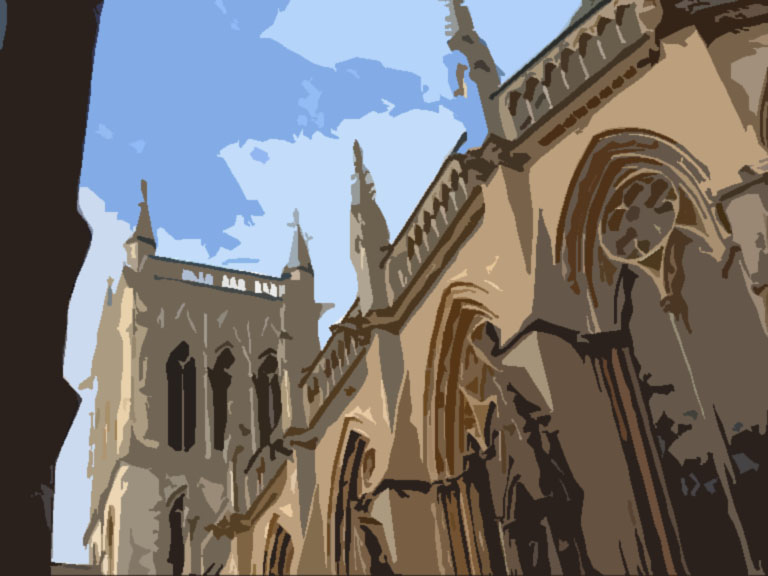
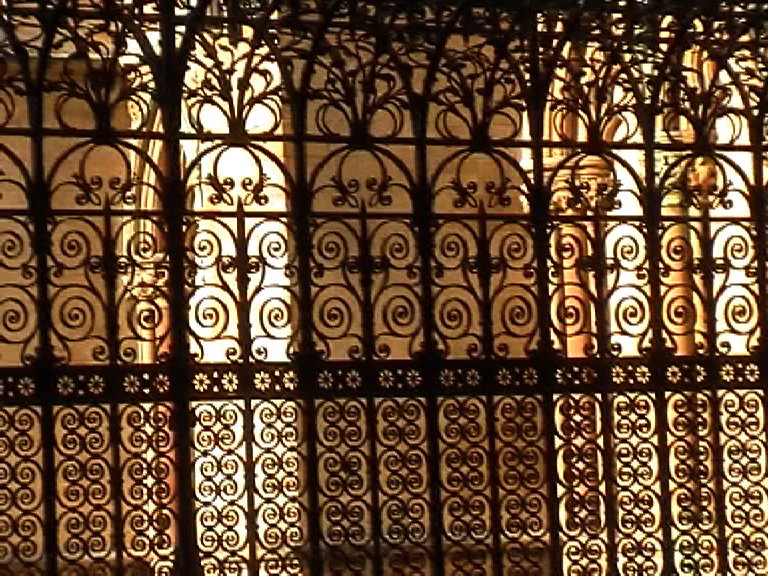
I was sitting on a low wall at St. John's Street, when I caught the chapel's tower behind me. The prominent landmark in this part of Cambridge was designed by Sir George Gilbert Scott in 1869, on top of the previous Medieval layer, even going back to the 13th Century. I did not have time to inspect the interior, but I also admired the trellis-work (shown below) as I waited at that particular corner.


I had coffee at Caffe Nero, which is the most preferred cafe chains on the high-street in the UK. Simply because an Italian friend of mine who had sampled the lot, remarked that Caffe Nero's coffee is the best of the lot! Well, when it comes to quality of food and drink, always trust the Italians! I decided to take a shot of the scene in front of me, and I quite like this one, taken of a couple deciding on what to eat and a young woman just coming into the main door.


Cambridge being the tourist attraction twelve months a year that it is, (it was a cold but sunny November when this was taken), needed to protect its narrow streets and created a pedestrian friendly environment, and as a result the streets' pavements have very low curbs. In fact, the vehicular service access route often flush with the pedestrian access route, but strict laws and enforcement deter vehicle drivers from breaking the law. And this ensured that the pedestrians enjoy walking on the streets. But be very careful of the "gung-ho" cyclists!


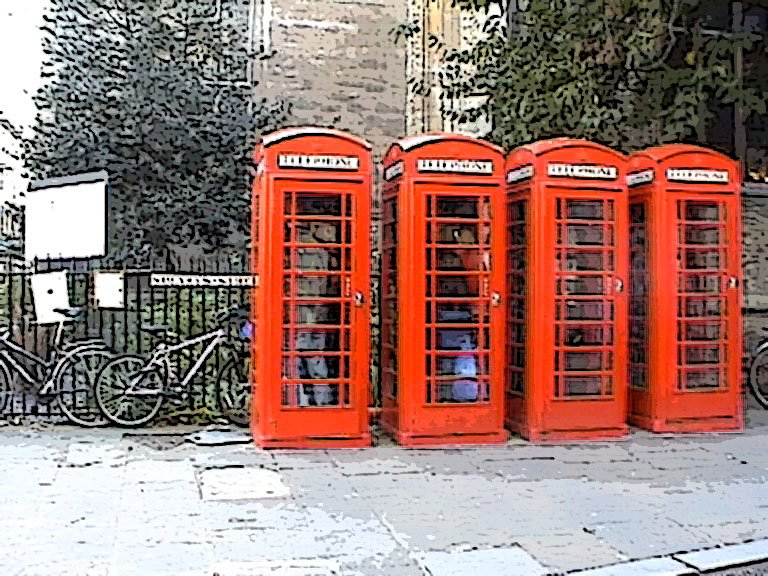
The last photo was taken at the corner of Market Street near St. Mary's Church, shows four old style telephone booths in a row, which I found to be well placed, compositionally, next to the bicycles tied to the fence behind, a sign of a pedestrian accommodating city.


(All photos except the "trellis" was doctored by Adobe Photoshop.)

Saturday, November 26, 2005

The Bridge of Sighs


What is it with "The Bridge of Sighs" you might like to ask?

I thought it might be a good idea to recount on my recent 12 days journey from Salford, to Cambridge, to the Cotswold, to South Wales and back to Salford starting with "The Bridge of Sighs".

I was in Cambridge for six nights, and stayed at one of the guest rooms at St. John's College for part of the stay. I had access to the private routes that tourists have limited access to, and one of these private places is the bridge. The photo above shows the openings and bars placed across, from inside the bridge, and the photo below shows the view, from the bridge, towards the 1960s part of St. John's College and people on the punts in the river, on that cold but sunny day. (Rendering by Adobe Photoshop for many illustrations shown in this post).


The bridge was built in 1831 during the early Victorian era, connecting the New Court with the Third Court. The first three courts of St. John's College, consisting of three cloisters of fine bricked buildings from the Tudorian era whereby, the New Court imitated the Tudorian flavour using stonework mostly, embellished with castellated motifs on the turrets and towers and the ribbed vaulting made of timber on the corridor's ceilings. This practice was common in the Victorian era. (See link.) This is shown in the photos below, the first showing one of the turrets of the New Court and the second is the corridor leading to the bridge.


The bridge is often referred to Venice's Bridge of Sighs or Ponte dei Sospiri, which is believed to be the inspiration. In the original version the sighs were coming from prisoners who were crossing the bridge in penitence. Hence the name. I wondered why the St. John's College version was named as such. They did name it "The New Bridge" in the beginning, and not "The Bridge of Sighs". Well, I am not sure whether the name is official or not. But it is fondly referred to as the latter, and it is the name used on their website.


Are the myth-makers trying to be "Romantic" either in the architectural style sense or alluding to the "lovers' sighs" variety? It is hard to imagine when you are in the narrow bridge which acts as a corridor, really... the thick bars placed on the windows alluded more to the "prisoners' sighs" as suggested in the Venice version rather than "lovers' sighs", or perhaps, we can all sigh heavily at the thought of being "prisoners in love"... I don't know. Do you?

The photo below shows the bleak and dark corridor further down, off the nicer middle bit of the bridge, but those bars... hmm? The start of a journey is always the middle of nowhere, I suppose...


Thursday, November 17, 2005

University Ranking - Continuing Saga

In the past few weeks, you would find many articles and press statements written on the dropped in ranking for University of Malaya to number 169. (Refer to earlier blog on this).

Just go the malaysia-today.net website and read the letters and comments sections in particular and you could see a link with Assoc. Prof. Terrence Gomez's case, previously, and this one. The issue is that the Opposition parties, mainly Lim Kit Siang, has taken to task the Government on many aspects of higher education. I cannot find any academics defending the university, apart from the vice-chancellor, (unless an academic does it under a pseudonym) nor was there any counter arguments.

Well, the ordinary lecturer working at the faculty level would not know what to say, but they may have some indication by way of directives and policies from the central administrators section / senoir management. The best people to talk about this is the professors that deal with the policies of the university.

One such professor is Prof Rom Tamjis.
If you must, please click on this link.

Friday, November 11, 2005

Inclusive Expedition - an interesting idea

First of all, what is "Inclusive Expedition", may you ask?

I am getting more interested with the idea of disabled people going jungle trekking, and then mountain climbing... well, I am getting interested about it myself, never mind others.

The last time that I did this was in 1995, before I went to London to do my masters course. There were four of us, ex-UTM architecture (diploma) students batch 1980-83. It so happens that we all went to UK around the same time to continue with our studies. Well, back to the expedition bit... We went walking around the jungle near Kenong Park, Kuala Lipis, for about 5 kilometers. It was not a big deal for my friends as much as it is for me, as I always get my leg caught in the roots and vines of the trees and foliage. After awhile it was painful and tiring, even though my friends helped to carry my rucksack. I did not really complete the journey as I missed out on the boat ride under the caves. But I felt a sense of immense accomplishment nevertheless.

Then recently, I watched "Beyond Boundaries", a reality tv show about a group of disabled people trekking from the Atlantic Ocean to the Pacific Ocean across Nicaragua for about 220 miles. They trekked through jungle, hilly terrain and climbed a volcano. The interest to watch this show and learn about it originally was more to do with Accessible Nature Conservation, but now it had branched out to "Inclusive Expedition"... Hey, I want some of that!

Watch this space, because I am thinking of writing more about this. But I would like to share first a link, about a lady who is disabled and did some fantastic volunteering work, within her interest of marine conservation.

Thursday, November 10, 2005

The Art of Groveling

The Art of Groveling...is that spelt with one 'l' or two, I am not sure...but one thing I know about the grovel artist is that, one needs a keen eye and a lot of consciousness what, how and when to beg, ie when to retract one's step as oppose to appear too keen and a tad too aggressive.

What do I know about this "art"? Well, I am a researcher. Is that enough reason to explain?

I had just been groveling to this person whom I wanted to get an interview done with him. Originally I did not need to grovel as he wanted to be interviewed, but it got confusing in terms of the day, ie Monday or Tuesday, and I had already written to about seven people based on the original date of intent of interviewing him, and I told him I had to contact seven other people and re-arrange with them in order to accomodate to a new date that he had confusingly wanted to be interviewed on...bla,bla,bla...

Well, of course, I want something from him, so I had to send another email this morning and grovel a bit. Not too much because we don't want to sound like we are desperate, do we? So, I said, yeah, well...these people probably are not going to see me, and he is the most important to meet anyway, so I did not mind seeing him whenever he wants to see me...so, isn't that groveling?

It is tiresome, a bit like lobbying, you know, you want something, so you try to sort of "hang around the other person's skirt", so you get to see "where the skirt sways" so to speak...sorry I do not have a better metaphor to explain this phenomenon, but that will do for now. Sounds a bit voyeuristic on hindsight, but what the heck!

Tuesday, November 08, 2005

More about Tracy Chapman

Tracy Chapman is intriguing. I mean, I just went to experience her concert yesterday. Her energy level is at maximum and she maintains it throughout the whole concert. There was a technical glitch in the middle and she could just continue singing cooly (read below on what she did way back when she had to fill-in an impromptu performance for Stevie Wonder during the Nelson Mandela 70th-birthday tribute concert). Her voice is amazing, it actually does capture the emotions for the right songs. She actually composed all those songs and the technical skill in musical arrangement! I cannot get over it. I think she is in the mold of Janis Joplin and all those icons of female musicians/singer/song-writer. Even amongst the male, she can match them. She is certainly up there with them. Scaling the giddy heights of creativity.

Just to share with you about Tracy Chapman, below, the article with this link:
http://www.about-tracy-chapman.net/biography2001.htm

Here's the biography.


biography ( © Nigel Williamson, Kent England, from the Collection booklet, 2001)

Ever since she burst upon the musical world in 1988 with her warm and magical debut album, Tracy Chapman has been one of our finest contemporary songwriters and a performer of striking originality, grace and charm. But she has also become much more than that.

When you walk out of a record store with a new Tracy Chapman album, you are not merely buying a collection of finely crafted and elegantly executed songs. You are also somehow entering a better world in which-for an hour’s worth of music at least-the values of compassion, honesty and humanity are restored to their rightful place in an otherwise increasingly giddy and trivial global culture.

Born and raised by her mother in Cleveland, Ohio, she began writing poetry and short stories at an early age. Tracy's first instrument was a ukulele that her mother bought her at three years old because she recognized that she loved music, and was later stolen by the girl across the street from them. There wasn’t much money in the family but her mother saved money from the household food money to purchase it from a neighborhood store.

An academic scholarship sent her to high school in Connecticut, where she played at chapel services, Her mother bought her first guitar when she was away in boarding school when she started playing coffee house at school with a borrowed guitar. Later, the school chaplain Reverend Robert Tate organized a collection to buy her a new guitar. (He was thanked years later in the credits on her first album.)
At Tufts University in Medford, Massachusetts, she studied anthropology and honed her musical skills on the Boston folk circuit, playing guitar and singing on the streets of Harvard Square and performing at local coffeehouses and the campus folk club.

By 1987, she had signed to Elektra, a label with a proud singer-songwriter history dating back to the 1960s heyday of the genre. Her self-titled debut album, produced by David Kershenbaum, was released in early 1988 and its warm, passionate and heartfelt songs announced the arrival of a compelling talent. At the time, the record was a breath of fresh air. By the late 1980s, music was dominated by synths and drum machines and the simplicity and sincerity of Chapman’s approach was hugely refreshing. The songs themselves were full of sharp observation, deeply rooted in her personal experience of growing up poor in a working-class community in the inner city.

The album met with immediate critical and commercial success, but it was an appearance at the Nelson Mandela 70th-birthday tribute concert at Wembley, London, in June that year that introduced her to a mass global audience. “They didn’t have a slot for me and I was kept waiting,” she recalls. “It was just me and my acoustic guitar and I think they called me three times hoping to put me on while the next act was getting ready.” On each occasion it didn’t happen, and three times she was sent back to the dressing room and told to wait again.

Then, just as Stevie Wonder was due to go on in a prime time slot, he told dismayed organizers that his computerized programs had gone missing and he could not appear without them. In a panic, they called for Chapman. “I literally had to run to the stage, dragging my guitar cable,” she recalls. “When I look back at the footage I can see how unprepared I was. But I think it also meant I had no time to feel the pressure.”

Her spontaneous performances, seen by millions on television around the world, was a sensation and the reaction was instant. She won so many hearts that the following week the album soared to the top of the charts in both Britain and the United States. Elektra had believed in her from the outset and hoped the album might sell 200,000 copies-a highly credible performance for a debut of basically acoustic songs. Instead, it went on to sell more that 10 million copies and win three Grammy awards.

But Tracy Chapman has never been an artist whose value can be measured in statistics and chart placings. For her, the awards and accolades have always been second to the integrity of her songwriting and the emotional honesty of her voice. Drawing on the songs she had written over the previous nine years, seldom can there have been a more perfectly formed debut album.

The irresistible Fast Car gave her her first hit single, a sharply observed tale of hope for a better life. It’s a powerful and moving performance, the infectious melody and jaunty rhythm juxtaposed dramatically with the seriousness ot its message about the difficulties of breaking the cycle of deprivation.

Baby Can I Hold You is simply on of the most beautiful love songs ever written, its perfect simplicity matched by its overwhelming poignancy. Astonishingly, Chapman was just 18 when she wrote the song. Talkin’ Bout A Revolution is another early composition and its deliberate positioning as the opening track of her first album announced her immediately as a songwriter with a passionate commitment to the causes of truth and justice, and who was not afraid to speak her mind. “Poor people gonna rise up and get their share,” she sings with such unswerving conviction that you believe implicitly in the inevitability of those tables turning. She’s Got Her Ticket, with its attractive reggae lilt, takes a similar theme to “Fast Car,” but is full of bright optimism-a fervently expressed hope that we all leave behind the “hatred, corruption and greed” and find our own “place in the sun.”

By the time of Crossroads, her second album released in the fall of 1989, Chapman was a platinum-selling superstar. But she had also earned huge respect as one of the most committed artists of her generation. The songs on her debut had dealt with such issues as violence against women, institutionalized racism and living on welfare. She had played the six-week long Amnesty International Human Rights Now tour with Bruce Springsteen, Peter Gabriel, Youssou N’Dour and Sting, and also lent willing support to a large number of other fund-raising benefits for good causes. “I’m a musician and a songwriter rather than an activist,” she says simply. “But I think it’s important if you are an artist to use your music to stand up for what you believe in.”

Crossroads immediately went platinum, although ultimately its sales did not match the success of her first album. Yet, in retrospect, as a collection of songs it is another towering achievement-rich in the depth of its emotion and acute in its social observation. Her strongly developed social conscience is evident in Subcity, in which she gives voice to the hopes and fears of the underclass who are too often denied of their own. The title track, Crossroads, is a more personal song that deals with maintaining a sense of self. “All you folks think you run my life, say I should be willing to compromise,” she rings a voice that leaves no doubt she won’t be compromising her beliefs for anyone.

The theme of the struggle to maintain integrity in a corrupt world has become a central pillar in Chapman’s work and All That You Have Is Your Soul, the third song included here from Crossroads, similarly urges us to “hunger only for a taste of justice.” The sentiments are offset by a simple but striking arrangement, which also features Neil Young, whom she had supported on tour.

It was almost three years before her next album, during which time there were further appearances at concerts in London and New York for Nelson Mandela (she had written “Freedom Now” on Crossroads for him), Farm Aid benefits, and an appearance at a Martin Luther King celebration. Matters Of The Heart, her third album, appeared in May 1992. Helmed by Jimmy Iovine (a more rock-oriented producer who had worked with Tom Petty, Simple Minds and Patti Smith), it featured many of the musicians she had met on the Amnesty tour.

As the title implied, Matters Of The Heart contained a greater preponderance of personal songs and several tracks appeared to deal with the loss of innocence. But it was another winning collection, represented here by Bang Bang Bang, the album’s most powerful song about the social hypocrisy regarding gun violence, and the gentle Open Arms, which contains perhaps the record’s most stricking melody. The latter includes soul legend Bobby Womack on guitar, a collaboration that was a particular thrill for Chapman. “I grew up listening to soul music and I was always drawn to songs that had a social commentary-like the music of Stevie Wonder, Harold Melvin & The Bluenotes, Marvin Gaye and Bobby Womack,” she says.

After a sabbatical, her fourth album, New Beginning, was released at the end of 1995. Co-produced by Chapman and Don Gehman, it was to rival her debut in terms of commercial success, selling within a year three million copies in America alone. It was also her most mature collection of songs to date, characterized by subtle arrangements that emphasized the immediacy of the melodies and the depth of her lyrical emotion.

New Beginning took as its themes change, growth and renewal. It was also a record imbued with healthy doses of idealism and hope. “We’re at a place right now, approaching the new century, where we could find new solutions to old problems,” Chapman declared optimistically at the time of the album’s release.

Four tracks are included here. The Promise is a song of gentle longing with a lovely string part counterpoised against her own delicate acoustic guitar. I’m Ready has an almost mantra-like quality that reflects the song’s spiritual themes of yearning and redemption. Smoke and Ashes is more up-tempo, with one of her most sensual vocals and a stirringly soulful chorus. But it was the bluesy Give Me One Reason that was to prove the album’s biggest hit single. She would later perform it at the 1997 Grammy awards with veteran bluesman Junior Wells on harmonica.

There was to be more than a four-year gap before her next album, but Chapman was not idle. She joined the Lilith Fair tour, played Tibetan Freedom Concerts, participated in a Bob Marley tribute in Jamaica and even performed at the White House in a benefit concert for the Special Olympics. Finally, her fifth album, Telling Stories, followed early in 2000. It was more than worth the wait. A subtle and lyrically complex collection of songs that reached new heights of poetic expression, the album found her reunited with producer David Kershenbaum for the first time in more than a decade.

Most of the songs appeared to have a loose theme. “They touch on different perceptions of reality-how we define, change, manipulate and corrupt it,” she explained on the album’s release. The driving title track, Telling Stories, has a memorable melodyand deals with the complexities of truth and its many different layers. The selections from the album included here are completed by Speak The Word, an elegant ode to the power of love, and the entrancing Wedding Song, with its striking imagery and haunting vocal.

Of course, a single album is hardly sufficient to contain all of the best songs of Tracy Chapman. Think of this rather as a collection that seeks to represent the best qualities of her songwriting-fearless insight, compelling social relevance, keen intelligence, emotional resonance and lyrical compassion.

In these songs, you might say, all that we have is her soul. And that is a very precious gift, indeed.

© Nigel Williamson
Kent, England
July 2001

Tracy Chapman's Concert

I went to Tracy Chapman's concert at the Apollo Theatre, Manchester, just seven hours ago. I went with two of my ex-students who are married to each other, and three of their friends.

I have never been to the Apollo before, only the MEN Arena to see Diana Krall last year, and really like the venue. It's an old style theatre with side balcony seats, but we sat at the stalls at row K. You can see very well, and the expression on Tracy Chapman's face. At the beginning of the concert, many people were shouting " I love you" at her, and she said, "We love you too", and some people said, "We love you more!" And she had to say, "Well, there's more of you than of us." It was so funny. And few people were drunk in the crowd and kept on yelling and screaming now and then, but she was not perturbed, and kept on singing. The energy from the crowd was real, whole and passionate. Clearly, the crowd really loved her.

It has to be a crowd of the "Revolution", ie more left wing than right that could love her. If you know Tracy Chapman, her first debut album was in 1988, and she sang most of her old songs from that album and the number one hit, "Give Me One Reason" after the encore. "That was one of the longest encore I ever experienced", said one of my ex-students. Tracy Chapman really made us wait.

What is Tracy Chapman like? How does a person be so creative and sing so well?
Who is Tracy Chapman?

So, I thought I would link to an article that was written about her, where she was quoted, that she does like cameras. "When we started making Where You Live, I bought a bunch of Polaroid cameras in so that people could record the experience. Some of those pictures are in the CD sleeve." Chapman, though, prefers the slow decision-making process of selecting a subject for her pictures with a pinhole camera. "It's like writing a song. You're choosing what to put in the frame and, with a pinhole camera, there's an infinite depth of field. There's a sense of influences and atmospheres seeping in and out. There's something magical about them. And songwriting is magical and mystical."

She sang quite a few songs from her new album entitled "Where You Live", and some were really good. I especially like "Change" where I am sharing the lyrics below.

CHANGE

If you knew that you would die today
If you saw the face of God and Love
Would you change?
Would you change?
If you knew that love can break your heart
When you're down so low you cannot fall
Would you change?
Would you change?

How bad how good does it need to get?
How many losses how much regret?
What chain reaction
What cause and effect
Makes you turn around
Makes you try to explain
Makes you forgive and forget
Makes you change
Makes you change

If you knew that you would be alone
Knowing right being wrong
Would you change?
Would you change?
If you knew that you would find a truth
That brings a pain that can't be soothed
Would you change?
Would you change?

How bad how good does it need to get?
How many losses how much regret?
What chain reaction
What cause and effect
Makes you turn around
Makes you try to explain
Makes you forgive and forget
Makes you change
Makes you change

Are you so upright you can't be bent
if it comes to blows
Are you so sure you won't be crawling
If not for the good why risk falling
Why risk falling

If everything you think you know
Makes your life unbearable
Would you change?
Would you change?
If you'd broken every rule and vow
And hard times come to bring you down
Would you change?
Would you change?

If you knew that you would die today
If you saw the face of God and Love
Would you change?
Would you change?

© 2003 Tracy Chapman

Monday, November 07, 2005

UK DDA Development

UK Disability Discrimination Act 1995 is going on the right course, based on reading some articles on the topic. By 2020, public transport in the UK will have to be accessible for everyone including wheelchair users.

I have included below an article from the Blackpool Gazette, where an inquiry from a Blackpool resident inquiring whether the newly proposed trams will be accessible. Having been to Blackpool for a stopover, the trams that run along by the beach front is a favourite among visitors and residents alike. The beach front connects many miles of entertainment spots from one end to the other, so I reckon the tram is the best way to get around. On the road traffic could be a nightmare there.

The issue is similar to what is happening in London, ie with the phasing out of the old double decker buses that we access from the back, if you had been on one of those. Yes, the name of those buses is the "Routemaster". So, in Blackpool they try to retain the heritage / vintage trams along with providing accessible new ones. Another issue relating to heritage.

TRAMS ON RIGHT TRACK
RE Mr Robathan's letter "Are easier access tram plans on the right track?"
(Gazette, October 11), I would inform your readers that under proposed Rail Vehicle Accessibility Regulations it is not an option to operate low-floor buses for passengers with disabilities and mobility problems as an alternative to making Blackpool Tramway accessible for such passengers.
The Rail Vehicle Accessibility Regulations require all trains, light rail vehicles and trams used on public transport services to be fully accessible to the disabled by 2020. Blackpool Transport firmly believes that the Blackpool Tramway must be made more accessible to the mobility impaired and that low-floor trams must be introduced on to the system as a consequence.
Having said that, as the guardians of 120 years of history, Blackpool Transport is actively campaigning for a partial exemption to be granted so that a future high frequency low-floor service can be supplemented with historic vintage trams.
It is the company's view that in the interests of both the disabled and those with great affection for Blackpool's heritage trams can both be catered for provided that all concerned are willing to reach a sensible compromise.
The situation will hopefully be clearer following a planned meeting with the Department for Transport in November.
STEVE BURD
Managing director
Blackpool Transport

Copyright 2005 Johnston Press Plc
Blackpool Gazette

Friday, November 04, 2005

Eidul Fitri Celebration

Yesterday was the official first day of Eidul Fitri celebration, because Malaysians celebrated it on that day.

I fasted a day earlier than Malaysians, as I followed the Liverpool Mosque declaration that we were to fast a day earlier. (Perhaps I feel more like a Liverpudlian than a Mancunian. Don't ask further.) So my first day of celebration was the day before yesterday. But never mind, in the end, we overseas Malaysian will tend to celebrate when our families do back home.

So my youngest brother called me at about 3 am yesterday as he just came back from the mosque with my mother. They were having their breakfast of rendang (stewed meat dish with spices and coconut milk) and lemang (sticky rice cooked in bamboo with coconut milk), and off they went after that to my other brother's house near our late father's grave. My two eldest niece and nephew of the two different bothers went as well. I was wondering how the two seven year olds felt when they saw my father's photo and they have never met him before and then they went to the grave while the adults around them recite Quranic verses. I mean, they must be too young to understand the concept of death.

Later on in the afternoon, my brother whose house is near the grave, called me and we talked about football of course, as both of us are Liverpool FC fans. We are excited with the prospect of Fernando Morientes getting fitter from his injuries and that he scored a crucial goal during the Champion League's group match on Tuesday. (Oops, digressing a bit here...)

This ritual is what we do every first day of Eid, and then everyone would get back to my brother's house and relax and watch tv and have lunch and this time around my mother will sleep at my brother's house and return the next day. She made 6 kg. worth of rendang, and has apportioned to both brother's families, her neighbour and herself. Well, I for once, am so missing her rendang. It's the best.

But as I was thinking that, a friend of mine invited me and two other friends to her flat in Salford. She made rendang for us! What a dear... Plus, nasi impit (rice boiled in coconut leaves cases), and chicken curry, and other goodies. We did not stay too long as one of my friends needed to be at the Cornerhouse, so we sent her there to meet her companion for a film show.

So the two of us went and ended the celebration of Eidul Fitri at a Manchester Spanish restaurant called, El Rincon de Rafa. I cannot resist telling why I like the name. It's the "Rafa" in it, as in the best manager that Liverpool Football Club had of recent years! Oops, I am digressing again.

Well anyway, we had only some tapas with our Appletisers, as we were not that hungry. We had artichokes, and that was good...something different. The usual mushrooms in creamy sauce, garlic bread, fresh baguettes and a really good portion of mussels. The dishes were good to excellent. Next time, maybe, we will be more hungry and try the seafood paella or something.

So that was my Eidul Fitri celebration in 2005, perhaps the last one that I will have in Manchester and the UK. I will need to get my work done now, as there is not much time before the expected hand-in.

BTW, Happy Eidul Fitri and Happy Divali to you out there if you are celebrating!

Monday, October 31, 2005

University Ranking 2005

There is a concern going on about the drop in ranking for Malaysian universities as indicated in the latest Times Higher Education Supplement 2005. University Malaya dropped drastically from 89 in the 2004 ranking to 169 in the latest 2005 ranking. Latest politician to voice this concern was Lim Kit Siang, and our Prime Minister also had mentioned about this the day before. Interestingly amongst the Asian universities, UM is way down as shown below. Other Malaysian universities could not even get to the top 200.

  1. Beijing University (China) - 15
  2. Tokyo University (Japan) - 16
  3. National University of Singapore - 22
  4. Kyoto University (Japan) - 31
  5. Hong Kong University - 41
  6. Hong Kong University Sci & Technol - 43
  7. Nanyang Tech University (Spore) - 48
  8. Indian Institutes of Technology - 50
  9. Chinese University of Hong Kong - 51
  10. Tsing Hua University (China) - 62
  11. Indian Institutes of Management - 84
  12. China University of Sci & Tech - 93
  13. Seoul National University - 93
  14. Tokyo Institute of Technology - 99
  15. Osaka University - 105
  16. National Taiwan University - 114
  17. Chulalongkorn University (Thailand) - 121
  18. Nagoya University (Japan) - 129
  19. Tohoku University (Japan) - 136
  20. Korea Adv. Inst of Sci and Tech - 143
  21. Hiroshima University (Japan) - 147
  22. Nanjing University (China) - 150
  23. Hokkaido University (Japan) - 157
  24. Shanghai Jiao Tong University (China) 169
  25. Malaya University - 169
  26. City University of Hong Kong - 178
  27. Korea University - 184
  28. Jawaharlal Nehru University - 192
  29. Showa University (Japan) - 198

The rankings are based on many criteria and the most glaring one is the Peer Review Score which is 40% of the overall score. UM got 33% out of 100% on that, which means that UM failed in the Peer Review evaluation.

That suggests that UM's academic is falling short of the desired quality that is expected . The lack of quality publication and research would be the case here. Peer review is about other academics evaluation of UM academics in the international scene. So even amongst the Asian academics, let alone the top 10 universities in US and UK, the other Asian academics don't think much of UM's academics.

Quoted from the article:
"The rankings use the results of a survey of 2,375 academics from across the world. These are combined with a series of measures including the number of times that research papers are cited by academics, staff-to-student ratios and number of students and staff from overseas.

This year's analysis includes for the first time a measure based on the views of international employers on which universities they prefer to recruit from."

The last statement above indicated that our graduates are not attractive enough for the global market. That itself is a loaded suggestion / question, which needs deep analysis, such as, what quality is required to enter the global market?

In UM, the usual thing is to wait for the Vice Chancellor to say something, but there should be a "bottom up" reaction to the problem first, feeding the VC with what is believed to be lacking and then the "top bottom" approach can be taken. That is if we want to be proactive about these things.

During our discussions in faculty meetings, we talk a lot. I mean there is so much banter going about on how to be better and so on, and we must compete with NUS and so on, but the action is only in rhetorics. There was no concrete follow through. There was no taking up of ideas to the next level, and there was no concerted effort to address the issues in terms of real targets that the academics can managed. We could dredge up many problems surrounding this issue, if we start looking in detail.
So, when shall we start to really look at this problem?


Saturday, October 29, 2005

Blogger's Business

I wrote this comment in Peter's blog...Again! Yes, just want to put my 'two cents worth' of lecturing input there! Anyway, I thought that I could put an argument about the accountability that bloggers have to make when they post something sensitive, especially those famous bloggers with hundreds of hits a day. So this is my first part of the argument which relates to Peter's post 'An Apology', in his weblog. (Refer to www.petertan.com)

Of Brand XX, sponsorship and charity.

What business are you in? If you are in the business of blogging, do you think that you can say anything, and not get commented upon. Or even complained about?

If you are a blogger and you seek for charitable funds only, then you are similar to a charity organisation. If you are a blogger, and you seek for personal sponsorship and you developed a brand, ie your style of writing, your fan base, your advertisement, your PayPal banner so that people can give money to you, etc, and your blog makes a compulsive read and which gives you rewards for your personal needs and income, say, you are similar to many business and corporations out there. Hence, Xiaxue's blog which overtly advertises itself and get sponsorship deals, and have so many hundreds of readers is - a business / corporation ,isn't it?

It is very simple.

Because the business is disabled friendly, meaning the writing has been putting down disabled people's rights, for example, "So tell me, our government spent millions of taxpayers money to build so many facilities for the physically disabled, and only they are allowed to use it?" (Xiaxue, Oct. 16) hence the business gotta be accountable for its action. Don't you think?

This is nothing new. Businesses get hit back a lot of times, because they are not disabled friendly or there is a cause to complain. We complained once in writing and in the media about an airline that took an hour for a friend of mine to disembark via his wheelchair as they did not do their business properly, and they were not courteous. I wrote to a shopping complex before about letting non disabled people park at designated car parks for the disabled, and I will not hesitate to cc to the Ministry of Local Government to put things right or to write to the media and make the business more accountable.

You know why I do this? Because there is no Disability Discrimination Bill in Malaysia (and if you want to know, neither is there a discrimination bill in most Asian countries including Singapore). If there was a bill as such, all I need to do is just complain to a Commission and they will act upon it, like in the UK, and get compensation. No need all these cc and writing to media stuff. Some other party will do the job for you. No need to get people to put you down in a blog like this. No headache!

But as it is in Asia, we have just got to grit our teeth and fight for our rights the best way we can, and complaining it is!

Do I want to be a pushover and let people walk over me and not get my rights heard? Of course not, and so do you. You may be a parent with small children, and elderly person, or someone who just got discriminated upon. So what do you do? Just lie down low and get stepped on?

Let's face it - businesses can get away with anything. Including the business of blogging. It's part and parcel of the 21st Century issues, but we know businesses are run by people. And people need to be accountable for their actions.

Thursday, October 27, 2005

We are no pushover

I have been quite busy nowadays but there is an issue that came up in Peter Tan's blog that I need to mention here. Peter actually wrote a post where he was appalled that a blogger had been insensitive to disabled people's issues and informed the blogger's sponsors of what she had done wrong, ie criticising and putting down disabled people's rights (which you can read via Peter's blog). So a lot of people left comments criticising Peter's action, which I think is not right as people think that disabled people such as Peter is manipulating 'our disability' to get at other people. The issue is not that simple. Hence I had placed my comment which I am pasting here:

Peter Tan was correct to fight back. I am backing what Peter did. I would have done the same. The reason being, people like Xiaxue thinks that she can say what she likes, which can undermine all the efforts of what people were trying to do, which is to fight for the Rights of Disabled People.

Yes, it did not happened overnight. Disabled people along with able-bodied people had been working alongside each other to produce guidelines on how to make the built environment more accessible. Usually it is done outside their working hours, where they worked voluntarily and sacrificing precious time away from family.

In Singapore where Xiaxue comes from, I know personally the individuals from the Singapore Handicapped Association who worked with the Singapore Government, such as the HDB, and the Public Works Department during the evening and weekends, sacrificing their spare time and their family time so as to get the guidelines for disabled toilets and other facilities on board for disabled people to use. They spent for years scouting the Orchard Road area, shopping complexes, government buildings etc making access surveys and giving free consultations to the officers in Government.

What happens in Singapore is made an example in Malaysia and other Asian and Pacific countries when in the 90s, UNESCAP adopted the Singapore guidelines and trained people from all over Asia to fight for the rights of disabled people. Although this is about Accessibility, it touches and effect many other issues relating to disability.

Many of us in this forum may not know that there are kids out there who are disabled that did not get further in life because the environment is disabling, for example, I know of people who stopped schooling just because after 12 years old their parents cannot carry them up the flight of stairs anymore, thus affecting their life’s chances. So many issues, that need to be at the forefront but we can only managed to highlight about Accessibility, which when looking at how developed countries had done it, were the first issues to be highlighted. We in Asia have still a very long way to go.

People need to understand that eventually they will all be handicapped in a way, as they grow older, and their hips and knees start to become arthritic and other ailments come. How to enjoy life when we are older? We see more and more elderly people going out around Orchard Road and other Singapore city spots. There are accessible toilets, so that wheelchairs can fit, lifts, brailled and tactile surfaces, places to sit, and so on, to make life a bit more bearable and enjoyable. For people who has spinal injuries, the time taken to wait for a disabled toilet, may result in him/her getting urinary tract infection, and making a setback to his/her condition, hence the need for people to be sensitive to not use disabled toilets.

If things are not accessible and disabled toilets are not available, how do people get to do what others can easily do?

Why criticise and deny disabled people their rights to living as you do?

So Brand Names like Xiaxue or whatever it may be (such as any other famous bloggers or personalities) or companies or whatever business out there, please be ready when you start critising and putting down disabled people and their rights. We will fight back. We are no pushovers! We know our rights and that is our privilege as human beings!

Friday, October 07, 2005

Pride and Prejudice


A couple of nights ago, I went to see the film, "Pride and Prejudice", based on a Jane Austen novel, capturing the fictional life of Elizabeth Bennet, her sisters and their parents during the Regency period of the Georgian era (late 18th and early 19th century).

Some things were of interest to me, namely;
How Dame Judi Dench and Brenda Blethyn tried to out-do each other with very high quality acting; How this was rubbed off and on to the younger actors like Keira Knightley and the guy who played Mr Darcy; How detailed and exquisite the film sets were in portraying Georgian England; How delicious it felt as the camera picked out the details of that era...etc

I was completely satiated in terms of the performances of the veterans, including Donald Sutherland, and adequately satisfied with the younger performers, but the set and cinematography, that was brilliant!

I wanted to go to Chatsworth, and in the film I was transported there! (That was Darcy's country house in Derbyshire, with the deer park!) And the script was funny! (in a good way)...I was laughing out loud throughout the film. I must admit that I have not read Jane Austen's novels, but now I think I will go and get the whole collection.

All in all, the film is an excellent "social commentary" on life during that period and I learned a lot from that. (It made sense now what Prof. Curl taught me during Architectural History class...) I am looking forward to indulge in "Oliver Twist" next, where I will be transported to the Victorian era, in industrial and congested London. Can't wait!

(Image taken from: http://www.chatsworth-house.co.uk/)

Saturday, October 01, 2005

Malaysian Accessibility Issues

I would like to highlight an article that was published in a Malaysian newspaper recently, whereby the Minister for the Ministry of Women, Family and Community Development made a statement criticising authorities in local government about the lack of commitment in providing accessible facilities for disabled people and elderly people.

There are a few things mentioned by the Minister. The statistics for elderly people was stated, but not for disabled people. We know that we do not have the correct statistics for disabled people done in the last census of 2000, because the census-taker did not ask about whether there is a disabled person in the household, as pointed out by many people. They could not use the Welfare Department's registration count as it only comes to less than 1% and United Nation's estimates are from 6-10%. So it seems that we will always be stuck when it comes to talking about statistics. Statistics is used to back-up arguments for funding and investment, so we will lose on that issue. The question is, are there any other way to get the right statistics in the near future or do we have to wait for the next census in 2010?

On this piece of news alone, part of the strategy is to go along with the needs of elderly people as part of the needs of disabled people. We cannot leave out elderly people's needs or to be exact, we must mention elderly people in the same breath as disabled people when we advocate about accessibility needs.

I have a feeling that because of statistical reasons, we have been stuck on developing and planning for disabled people in Malaysia, and that is also the reason for the Disabled Person's Act being stuck in Parliament. What do you think?

If you can read in Malay, the article is shown below :

Shahrizat bidas PBT ketepi OKU, warga emas

KUALA LUMPUR: Datuk Seri Shahrizat Abdul Jalil membidas sikap pihak berkuasa tempatan (PBT) kerana tidak komited dalam menyediakan kemudahan prasarana untuk warga emas dan Orang Kurang Upaya (OKU).


Malah, Menteri Pembangunan Wanita, Keluarga dan Masyarakat itu turut meluahkan rasa tidak puas hati dengan tindakan PBT yang hanya mengutamakan kemudahan untuk golongan sihat dan muda.

Beliau berkata, PBT seharusnya menjalankan tugas tanpa mengetepikan kepentingan warga emas yang jumlahnya dijangka meningkat kepada 3.2 juta pada 2020, berbanding 1.66 juta sekarang.

PBT serta Jabatan Perancang Bandar dan Desa perlu merangka pembangunan dengan menyediakan kemudahan yang mesra warga tua dan OKU yang sememangnya banyak disediakan di negara maju dunia.

Sektor swasta juga wajar bekerjasama dalam hal ini dan tidak hanya menyerahkan tanggungjawab untuk mewujudkan prasarana kepada warga emas dan OKU kepada kerajaan semata-mata.

Dalam hal ini, PBT perlu memastikan setiap projek pembangunan yang dilaksanakan swasta terutama di bandar mengambil kira kepentingan warga tua termasuk kemudahan lif, tangga, landasan pejalan kaki dan tandas,
katanya selepas melawat Pusat Jagaan Harian Warga Tua Kampung Cheras Baru dekat sini, semalam.

Turut hadir timbalannya, Datuk G Palanivel, Setiausaha Parlimen; Chew Mei Fun dan Ketua Pengarah Jabatan Kebajikan Masyarakat, Datuk Shamsiah Abdul Rahman.

Shahrizat berkata, sektor swasta juga diharap dapat menyumbang dengan membina lebih banyak pusat jagaan harian atau perumahan khusus untuk kedua-dua kumpulan sasar itu

Kita memohon untuk mendapatkan peruntukan tambahan bagi menambah bilangan pusat jagaan harian dalam komuniti pada Rancangan Malaysia Kesembilan (RMK-9).

Kenaikan elaun kepada warga emas juga dikemukakan. Ketika ini 23,500 menerima peruntukan elaun RM28 juta,
katanya.

Selain itu, katanya, pihaknya sedang menjalankan kajian semula Dasar Warga Emas Negara dan Pelan Tindakan Warga Emas bagi memastikan ia relevan dengan keperluan dan cabaran semasa.

Warga emas ditetapkan bagi individu berusia 60 tahun ke atas, bagaimanapun ketika ini pada usia 50 tahun didapati kebanyakan individu masih sihat dan mampu menyumbang khidmat kepada negara,
katanya.

Berikutan itu, kajian semula dijalankan bagi memastikan tenaga mereka tidak disia-siakan,
katanya.


©The New Straits Times Press (M) Berhad