Tuesday, January 31, 2006

Weybourne Beach, the pebbly one.

Pebbles, pebbles everywhere...all deliciously round...
Crunch, crunch, as I walked...making the sound
(author)


Weybourne Beach, as you come from the car parking area and looking left
where you see the rise of the edge of the land where the erosion starts.


Smooth rounded pebbles of different shades of colour can be found here.


Weybourne beach is located on the Norfolk coast. The beach is full of pebbles, rather than sandy, and as you walk along the edge of the land that meets the beach, you would have noticed erosion exposing more pebbles embedded in these edges of soil and sand.

You can find flint here. A type of stone that people in this area used to make fillers for houses's walls and walls around their gardens. You see by the roadside all the walls are made of these. It is believed that, "flints can reach the size of a cat and may have a coat (cortex) of white or brown. Inside a nodule, colours range through yellows and reds, browns and whorls of pale grey." But the flint stones found were too small to be used for walls.

"Almost pure silica, any impurities give different colours and qualities. Jet black flint is the most pure and is specific to Grimes Graves in Norfolk, whilst a white flint is found only in parts of Lincolnshire...Because flint shines and fractures like glass, it became highly sought after by our early forbears for its hardness and capacity to chip to a sharp tough edge. Four thousand five hundred years ago people were mining 14 metres below Norfolk at Grimes Graves near Thetford, where over 400 pits are evident. This, one of Europe's earliest industrial centres, was a unique source of beautiful black flint, which was expertly fashioned into axe heads for tree felling, as well as saws, knives, axes, scrapers and arrow heads." (Info. found in this link.)

We did not go and visit Grimes Graves, but traveled through many towns in Norfolk, and remarked along the way about the usage of flints everywhere. It seems that there are other coastal towns apart from Norfolk and Suffolk in East Anglia that uses flint. Brighton in Sussex is famous for its pebbly beaches, too.

Link on Grimes Graves, Flint Knapping etc.

Pic. taken from this website, showing an old church in Weybourne and the walls made of flint.

A finger touching one of the flints protruding from the edge.


Weybourne beach is not for sun-bathing and it did not attract the usual crowds but people who would like to have a quiet walk along the beach, or throw stones into the water, or examining the geological treasure abound. The beach is also a working beach where boats come in from the day's catch. There are plenty of boats moored inland when I went there almost nearing sunset on an April's evening.

There is a myth about a "whistling ghost" on this beach as often the locals could hear persistent whistling, and they even spotted a "chap" with old clothes from far, but when pursued, the chap had vanished. We did not wait around for dusk to descend as the roads were not that familiar and some parts have no lighting. It was kind of sad leaving this pebbly beach and Norfolk. It was a good journey.

Crunch, crunch, I made the sound...


The place I stayed was made of flint!

Sunday, January 29, 2006

The Winner of the Whitbread Book of the Year Award 2005

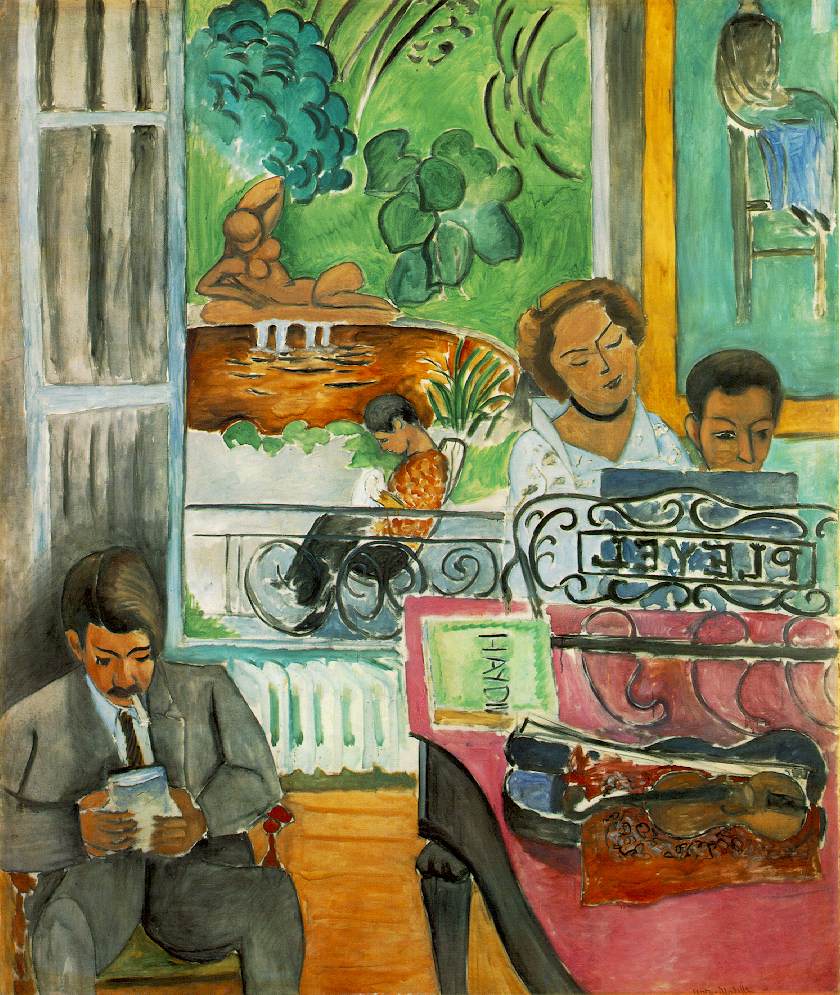
[Pic. of Matisse's "lecon-musique" can be seen on this website.]

The headlines said,
"Biographer Hilary Spurling has won the prestigious 2005 Whitbread Book of the Year award for the second part of her masterful biography of Matisse, Matisse the Master, a work which took her 15 years to complete. "

The other day, I noticed this book, and I really wanted to buy it. Before the author won the award. Spurling told an interviewer, in the beginning, the experts were not very encouraging as they said that Matisse's life was considered to be boring. But she thought, how could someone who painted so wonderfully could be boring, and true enough, when she researched documents, including correspondences and family papers obtained from Matisse's grandchildren, she unearthed a character arguably more interesting than Picasso. (See article.)

I really have a lot of respect for someone who can make a biography a joy to read. I flicked through the book, and it was something that I would love to read.


[Pic. of Matisse's "robe-violette-anemones" can be seen on this website.]

Guidelines of writing and getting a book published.

Friday, January 27, 2006

I don't want to be a broken record


I feel strongly about my identity as a Muslim and being a Malay. These two identities are not separated or alien to one another, but are inter-linked very closely.

I was born in Bentong, Pahang in the General Hospital. At the age of four and half, my family moved to Penang, whereby in the year 1973, my mother, my brothers and I, at the age of 11, joined my father in San Diego, U.S.A. I left my family two years later as I was given a place to study at a boarding school in Seremban, Negri Sembilan. Two years later, my family came back and stayed in Kuala Lumpur. And since 1977, I had always stayed in Kuala Lumpur apart from the 11 years of studying abroad in the U.K. at different stages of my adult life.


I believe that my identity as a Muslim, has been the "rudder" of my sanity. Another controlling mechanism was my parent's influence. My brothers and I were free to think about our lives, but always with some parental advice at hand. Never forced upon us, so we learned to think for ourselves.

However I would rather perceive my identity as a Malay linked to the place I was born, the context to which I grew up in and where my parents and grand-parents came from. My identity as a Malay or rather as a Sumatran/Rawa/Khmer(?) helped to negotiate my bearings and direction in life. The best way to describe that influence is that I feel my Malayness in my blood, in my place on this earth and in my vocation.

Another way of explaining about myself is that I feel the need to thrive on rediscovering my identities. Life is not static. I change as I grow older and discover myself from different viewpoints and perceptions. I adapt to the change by adopting certain values and I see it as enriching my being. The "rudder", however, is always there, sometimes hard and determined and sometimes loose and carefree. But, it is always there...


I don't want to be a broken record and most of all to myself, never mind others. I think it is important that I see my identity as a Muslim, being refreshed when needed as I grow and mature accordingly. What I learned at the age of 13, 23, 33 and 43 need to have a different meaning and perspective to it. If not you get "stale", like a mouldy bread, invaded and useless...

I am reflecting on why I had undertaken a PhD research topic that exclusively investigated the U.K. context and not Malaysia. Is that not a contradiction between my Malayness that I professed before? I beg to differ and clarify that I think it is important to understand concepts and abstracts of meaning and constructs of our self in grappling with idealism and intellectuality. Yes, each of us has that, idealism and intellectuality, but in learning about others, our culture becomes more focussed and intense. We could see better.


[To be continued...]

Tuesday, January 17, 2006

Borders Book Sale


A boat near the Swansea dock

I really had a good time last night rummaging through the calendars for sale at more than half their original price. It was crazy with some selling for two pounds, when the original price was five times more. There were so many calendars (well, it is January 17th already), and this branch of Borders bookshop had only recently been opened, so you could imagine that not many customers had patronized the place, and / or that they had not envisaged what type of customers would frequent this store. (Maybe not the buying calendars type...)

We bought quite a few calendars (to be used as posters) and there were many discounted books as well. I feel like going there again, as for sure there would be many bargains later this week. I really like bookshops and in Manchester there are not many of those delicious small bookshops where you could find a bargain and having a Borders 7 minutes drive away is some sort of small happiness to me.

I remembered when I used to work in central London near the University College area, I frequented my favourite bookshop every lunch time. What I did was to quickly swallow the sandwich and crisp with an apple juice, and spent the rest of my lunch time at the bookshop. I was into spirituality books a lot at one time, and there was this little bookshop near Duke Street where I was being satisfied a lot with the extensive choice on this subject.

Nowadays, I just cannot find time to relax with a book, with the thesis hanging on top of my head, and I longed to be able to relax again.

Saturday, January 14, 2006

Annie Proulx and Brokeback Mountain


I went to see the movie "Brokeback Mountain" with Stephie, last night. I needed a break from work and a friend said that it was a brilliant film and advised me to bring lots of tissues…so I did. (Yes, I used the tissues, and the film, is to me very deep, very well acted and excellently made. I think that was a really good combination, where Ang Lee, the director, did an Annie Proulx story. Ossana and McMurtry did very well with the adaptation.)

I was excited to see the film for so many reasons, and one of them was because E. Annie Proulx was the author of the short story which it is based upon. I went to amazon.co.uk and found out that the book is only 58 pages long.

A couple years ago, on British television, I had seen a documentary on how Ms Proulx researched for a work of fiction, focusing on "That Old Ace in the Hole". She took months to travel and interview people living and working in the panhandle country (Texas and the states around Texas), and went back with boxes of notes, to her place in Wyoming and wrote the book. I have a copy of the book on my shelf. The book is very well researched and the stories are really interesting, but every paragraph has so much research into it, you have to read it really slowly. So finely written and detailed. The only other book that I read was "The Shipping News." And that was also translated into celluloid.

When I saw "Brokeback Mountain", I could feel the details were very true vivid. They really made the movie accurately based on the book and this fact is reflected on Ms Proulx observations below. Because of the success of Brokeback Mountain, Ms Proulx was inundated with so many interviews and have now declined to do any more. I leave you with an excerpt of the interview page in Proulx's website and a full extract of the interview that she did with the Missouri Review, which was done before the film came out, and which she herself quoted on her website. (The pic used in this post is from amazon.co.uk).

On "Brokenback Mountain":
>>>
Interviewer:
How did you feel on first seeing the film?

Proulx:
Knocked for a loop. I had no idea of what to expect as I had had no input into the making of the film beyond some conversation with Diana Ossana and Larry McMurtry when they were writing the screenplay, and a letter to Focus president James Schamus and Ang Lee begging them to keep the language of the story intact. I did not visit the set. I feared the landscape on which the story rests would be lost, that sentimentality would creep in, that explicit sexual content would be watered down. None of that happened. The film is huge and powerful. I may be the first writer in America to have a piece of writing make its way to the screen whole and entire. And, when I saw the film for the first time, I was astonished that the characters of Jack and Ennis came surging into my mind again, for (hence the lie in Missouri Review ) I thought I had successfully banished them over the years. Wrong.
<<< Interview with Annie Proulx in 1999

by TMR Staff


Interviewer:
Your stories and novels cover a lot of ground, historically and geographically. Accordion Crimes, for example, is set all over the United States and spans much of the twentieth century. Postcards concerns World War II and post-World War II America. Can you talk about that?

Proulx:
Place and history are central to the fiction I write, both in the broad, general sense and in detailed particulars. Rural North America, regional cultures in critical economic flux, the images of an ideal and seemingly attainable world the characters cherish in their long views despite the rigid and difficult circumstances of their place and time. Those things interest me and are what I write about. I watch for the historical skew between what people have hoped for and who they thought they were and what befell them.

Interviewer:
Even your novels and stories that aren't strictly historical all have a sense of history and place somehow going together and being at the center.

Proulx:
Much of what I write is set in contemporary North America, but the stories are informed by the past; I like stories with three generations visible. Geography, geology, climate, weather, the deep past, immediate events, shape the characters and partly determine what happens to them, although the random event counts for much, as it does in life. I long ago fell into the habit of seeing the world in terms of shifting circumstances overlaid upon natural surroundings. I try to define periods when regional society and culture, rooted in location and natural resources, start to experience the erosion of traditional ways, and attempt to master contemporary, large-world values. The characters in my novels pick their way through the chaos of change. The present is always pasted on layers of the past.

Interviewer:
You studied history at the University of Vermont and Sir George Williams University, now Concordia University, in Montreal. Was there a particular approach to history that most interested you?

Proulx:
I was attracted to the French Annales school, which pioneered minute examination of the lives of ordinary people through account books, wills, marriage and death records, farming and crafts techniques, the development of technologies. My fiction reflects this attraction.

Interviewer:
Had you already decided to write fiction during your university years?

Proulx:
No, while I was studying history I had no thought of writing fiction and no desire to do so.

Interviewer:
Was there any pivotal moment that propelled you toward writing fiction?

Proulx:
The pivotal moment was not a moment but a slow, slow turning. I left graduate school and the study of history to live in Vermont's Northeast Kingdom with a friend. We were in a remote area with limited job possibilities; I started writing nonfiction, mostly magazine journalism and how-to books, for income. At the same time I began to write short fiction, mostly stories about hunting and fishing and rural life in northern New England, subjects that interested me intensely at the time. Almost all of these stories were published in Gray's Sporting Journal, then a new and strikingly beautiful quarterly concerned with the outdoor world in the same way Hemingway's Nick Adams stories are about the outdoor world—the primary weight on literature, not sport. There was an intense camaraderie and shared literary excitement among the writers whose fiction appeared in Gray's, something I have never encountered since. It may have been that the struggles to get paid by Gray's created a bond of shared adversity among the writers; it may have been the genuine pleasure in being part of this unusual publication that valued serious outdoor writing in contrast to the hook-and-bullet mags. It is hard to overestimate how important Gray's was for many of us. Without it I would probably never have tried to write fiction.I continued writing short stories in a desultory way for the next five or six years. When my youngest son left home for school in the late 1980s, for the first time in my life I enjoyed long periods of unbroken time suited to concentrated work and began my first novel, Postcards.

Interviewer:
In your latest book, Close Range: Wyoming Stories, you have returned to the short story. Can you talk about the differences between that form and the novel?

Proulx:
The construction of short stories calls for a markedly different set of mind than work on a novel, and for me short stories are at once more interesting and more difficult to write than longer work. The comparative brevity of the story dictates more economical and accurate use of words and images, a limited palette of events, fewer characters, tighter dialogue, strong title and punctuation that works to move the story forward. If the writer is trying to illustrate a particular period or place, a collection of short stories is a good way to take the reader inside a house of windows, each opening onto different but related views—a kind of flip book of place, time and manners.

Interviewer:
Interesting analogy. Speaking of which, your fiction sometimes seems to ride on a magic carpet of metaphor. How do you do it?

Proulx:
Metaphors—a complex subject. What is involved in constructing them seems not so much a matter of seeking similitude or trying for explanation or description as multilevel word and image play. Metaphors set up echoes and reflections, not only of tone and color but of meaning in the story. The use of running metaphors in a piece—all related in some way to indigestion or water or loneliness or roller skates, or with a surrealistic or violent cast—will guide the reader in a particular direction as surely as stock can be herded. For me, metaphors come in sheets of three or four at once, in floods, and so metaphor use often concerns selection rather than construction. There are private layers of meaning in metaphor that may be obscure to the reader but which have—beyond the general accepted meanings of the words—resonance for the writer through personal associations of language, ideas, impressions. So the writer may be using metaphor to guide the reader and deepen the story, for subtle effects but also for sheer personal pleasure in word play.

Interviewer:
It sounds like it's a natural mode of thought for you.

Proulx:
I was very young, about three years old, when introduced to metaphor, and I remember the first sharp pleasure I felt in playing what seemed a kind of game. I was with my mother in the kitchen of our small house. Classical music came out of the radio, I have no idea what, some sweeping and lofty orchestral statement. I was not consciously listening until my mother, who was a skilled watercolorist, said, "What does this music make you think about, what do you see?" Immediately I translated the music I heard into an image. "A bishop running through the woods," I answered. I had no idea what a bishop was but liked the word for its conjunction of hiss and hiccup. What the music made me see in my mind's eye was a tall, glassy, salt-cellar figure—the bishop—gliding through a dark forest dappled with round spots of light. The connections of perception between the sounds of the music and the image of trees / slipping figure / broken light had been made. Thereafter, and forever more, I found myself constantly involved in metaphoric observation.

Interviewer:
Do you have a standard operating procedure in the way you work? Do you start with place, or history, or character and story, or is it different with each book?

Proulx:
Where a story begins in the mind I am not sure—a memory of haystacks, maybe, or wheel ruts in the ruined stone, the ironies that fall out of the friction between past and present, some casual phrase overheard. But something kicks in, some powerful juxtaposition, and the whole book shapes itself up in the mind. I spend a year or two on the research and I begin with the place and what happened there before I fill notebooks with drawings and descriptions of rocks, water, people, names. I study photographs. From place come the characters, the way things happen, the story itself. For the sake of architecture, of balance, I write the ending first and then go to the beginning.

Interviewer:
What's your approach to research?

Proulx:
The research is ongoing and my great pleasure. Since geography and climate are intensely interesting to me, much time goes into the close examination of specific regions—natural features of the landscape, human marks on it, earlier and prevailing economics based on raw materials, ethnic background of settlers.

Interviewer:
Where do you go for that kind of information?

Proulx:
I read manuals of work and repair, books of manners, dictionaries of slang, city directories, lists of occupational titles, geology, regional weather, botanists' plant guides, local histories, newspapers. I visit graveyards, collapsing cotton gins, photograph barns and houses, roadways. I listen to ordinary people speaking with one another in bars and stores, in laundromats. I read bulletin boards, scraps of paper I pick up from the ground. I paint landscapes because staring very hard at a place for twenty to thirty minutes and putting it on paper burns detail into the mind as no amount of scribbling can do.

Interviewer:
Have you ever fallen in love with one of your characters?

Proulx:
I have never fallen in love with one of my characters. The notion is repugnant. Characters are made to carry a particular story; that is their work. The only reason one shapes a character to look as he or she does, behave and speak in a certain way, suffer particular events, is to move the story forward in a particular direction. I do not indulge characters nor give them their heads and "see where they go," and I don't understand writers who drift downriver in company with unformed characters. The character, who may seem to hold center stage in a novel, and in a limited sense does, actually exists to support the story. This is not to say that writing a character is like building a model airplane. The thoughtful and long work of inventing a believable and fictionally "true" person on paper is exhilarating, particularly as one knowingly skates near the thin ice of caricature.

Interviewer:
I'm curious about Loyal Blood in Postcards. What was his germ?

Proulx:
The character Loyal Blood leaped complete and wholly formed from a 1930s Vermont state prison mug shot. A friend gave me a small stack of postcards sent out by the Windsor Prison warden's office in the 1930s to alert various sheriffs around the state to escapees. I knew nothing of the man on my postcard, but his face was arresting and the character jumped forward at once. The story's genesis was sparked by a small stack of state fire marshal's reports during the Depression. There were a number of dismal accounts of farmers burning down their houses and barns for the meager insurance money. They had nothing else. From this desperate arson, with its roots in the global economic slump, emerged the story.

Interviewer:
Economic desperation is a common theme in your work.

Proulx:
The failure of the limited economic base for a region, often the very thing that gave the region its distinctive character and social ways, is interesting to me. I frequently focus on the period when everything—the traditional economic base, the culture, the family and the clan links—begins to unravel. I have taken a fictional look at this situation in northern New England, Newfoundland and Wyoming. In Heart Songs I began to examine the decline of the small dairy farms that had been the backbone of northern New England's economy since the late eighteenth century, but which began to break down after the Second World War and finally collapsed in recent decades as moneyed outsiders poured into the state. Postcards continued and enlarged on this theme, taking as its landscape the sweep of country from New England to California. The character Loyal Blood denies his natural calling as a farmer. He picks up a dozen different regional occupations on his long journey westward, an ironic and miniature version of the American frontier expansion westward. There is a subtext on the tremendously important rural electrification program. The novel was concerned with what happens when a region has only one economic base and it goes under—the breakup and scattering of families, the subdivision of land, the outflow of old residents or the new position they adopt as service providers to the rich moving in. A population shift of moneyed second-home owners began to replace seventh-generation farm families.

Interviewer:
We see a similar concern in The Shipping News, as well as in Close Range.

Proulx:
If all you have is fishing and the fish stock begins to collapse from overfishing, destructive pressures, foreign and domestic policies, etc., what happens to the fishermen who have no other way to make a living? Relocation, government programs and the like. The Shipping News caught a Newfoundland fishing outport on the edge of the abyss. A few months after the novel was published, the Canadian government proclaimed a moratorium on cod fishing, and the traditional culture and economy quickly began to dissolve as thousands of out-of-work Newfoundlanders streamed onto the mainland, an exodus that continues. In Close Range, a collection of short stories set in Wyoming, the focus was again on rural landscape, low population density, people who feel remote and isolated, cut off from the rest of the world, where accident and suicide rates are high and aggressive behavior not uncommon. Fifty percent of the University of Wyoming's graduation class must leave the state to find work. Again I was interested in looking at a limited economic structure—cattle ranching and extractive industries. What happens when the coal and oil run out, when the beef market falls away, when there are few chances outside the traditional ways of life? On a more intimate scale the stories explore human relationships and behavior, the individual caught in the whirlpool of change and chance.

Interviewer:
In Accordion Crimes you add another layer to the issue of economic struggle by focusing on the immigrant experience in particular.

Proulx:
I was interested in the American character, unlike that of any other country—aggressive, protean, identity-shifting, mutable, restless and mobile. I wondered if the American penchant for self-invention was somehow related to the seminal immigrant experience, in which one had to renounce the past, give up the old culture, language, history, religion, even one's birth name, and replace the old self with American ideals, language, a new name and new ways. The novel looked at several generations of nine ethnic families through the medium of the immigrant's instrument, the accordion.

Interviewer:
Do you believe that the ethnic variety of our nation—despite the "melting pot" history—is somehow forgotten or underappreciated?

Proulx:
A major aim in writing Accordion Crimes was to show the powerful government and social pressures on foreigners that forced them into the so-called melting pot. The social pressures were enormous, and the cost of assimilation was staggering for the immigrants—their lives were often untimely truncated. They did not belong, they were ridiculed outsiders, they worked at the most miserable and dangerous jobs. They gave up personal identification and respect. The successes went to their children, the first generation of American-born. These American children commonly rejected the values, clothing, language, religion, food, music of their parents in their zeal to be 100 percent American. Hence the widespread disdain in America (nowhere else) for the accordion. Canada allowed its immigrants a large measure of cultural autonomy, and ethnic enclaves and settlements grew up in many regions, the so-called ethnic mosaic that contrasts with the melting-pot symbolism. Ironically, it is Canada that is plagued now by a separatist movement.

Interviewer:
Does that imply that although the melting pot was responsible for suffering in the first generation of immigrants, it was the best thing for the nation?

Proulx:
My thinking does not sort out this way—"best," "worst," etc. The so-called melting pot is a vivid phrase that represented a dominant, narrow and forceful attitude in the United States in the late nineteenth and early twentieth centuries. That social and cultural attitude had no tolerance for ethnic, cultural or linguistic diversity. Immigrants had to become "American" in order to succeed here. Many of them did not and could not conform to the American ideal, and they lived their lives in sometimes dangerous backwaters. It isn't a question of whether or not it was the best thing for the nation or no. It was what it was, an expression of the American national character in that period. It was different in Canada—not better or worse, but different.

Interviewer:
I can't resist asking you one question about your experience with Hollywood. I understand that your experience with making The Shipping News into a movie has been a little frustrating.

Proulx:
I sold the film rights to The Shipping News several years ago and so have no influence on, connection with or input into the fate of the novel in Hollywood's fumbling hands. It was important to me during the option negotiations to plead that the film be made in Newfoundland, and the studio signed a letter of intent to that end. The seesaw history of the work since then, the inaccurate reports, the gossip, the confusion, is best learned from other sources than me. I am out of the loop.
The film rights of the short story "Brokeback Mountain," the closing story in the new collection Close Range, were optioned by Larry McMurtry and Diana Ossana, who wrote an exceptionally fine screenplay. What happens next with it remains to be seen.

Interviewer:
You have won numerous literary prizes, including the Pulitzer and the National Book Award. How has all the recognition affected your work?

Proulx:
I don't think prizes have affected me as much as they have my publisher. It is pleasant to have one's work recognized and praised, and prizes certainly have an effect on the way the body of work is perceived, and on one's income, but for me, when the manuscript of a story or novel is completed I am done with it and on to new work. I have a feeling of detachment for awards, perhaps because they come a year or more after publication, perhaps because it is difficult to believe that the work is considered prizeworthy. I am critical of my writing and tend to see the flaws and weaknesses. The best time for an award would be the instant one finally makes a stubborn paragraph or sentence lift its own weight off the page.

Interviewer:
How important to you are the responses of your readers?

Proulx:
Response of readers . . . depends on which readers you mean. Readers come in a highly variable assortment—critics, other writers, old friends, fans, reading groups, adversaries, error-chasers, punctuation mavens, clever scholars, those who deeply understand the territory of the book or story, those who don't get any of it. Probably I value the response of fellow writers most highly because they under-stand the work of making fiction. But fine letters have come from every kind of reader, and I am grateful for them.

Interviewer:
What, above all else, do you want your readers to take away with them after reading your works?

Proulx:
The novel should take us, as readers, to a vantage point from which we can confront our human condition, where we can glimpse something of what we are. A novel should somehow enlarge our capacity to see ourselves as living entities in the jammed and complex contemporary world.

Interviewer:
You have been criticized by some for overemphasizing the bad luck and failure of you characters—for not finding the mitigating factor in their lives, if only in the way you frame their stories.

Proulx:
It is difficult to take this as a serious criticism. America is a violent, gun-handling country. Americans feed on a steady diet of bloody movies, television programs, murder mysteries. Road rage, highway killings, beatings and murder of those who are different abound; school shootings—almost all of them in rural areas—make headline news over and over. Most of the ends suffered by characters in my books are drawn from true accounts of public record: newspapers, accident reports, local histories, labor statistics for the period and place under examination. The point of writing in layers of bitter deaths and misadventures that befall characters is to illustrate American violence, which is real, deep and vast.

Interviewer:
The rural farmers of Heart Songs, the unlucky owners of the accordion in Accordion Crimes, the fatalistic westerners in Close Range: they're on the ragged edge, and often—too often, some critics would say—they fall off.

Proulx:
Immigrants to this country suffered unbelievable damage, both psychological and physical. Rural life, too, is high in accident and, for many, suffused with a trapped feeling, a besetting sense of circumstances beyond individual control. Real rural life, enlivened with clear air, beautiful scenery, close-knit communities and cooperative neighbors, builds self-reliant, competent, fact-facing people; but it is also riddled with economic failure, natural disaster, poor health care, accidental death, few cultural opportunities, narrow worldviews, a feeling of being separated from the larger society. Literary critics who live and work in urban and suburban milieus characterized by middle-class gentility and progressive liberalism are rarely familiar with the raw exigencies and pressures of rural life.
I am reminded of the uproar of disapproval over historian Michael Lesy's 1973 Wisconsin Death Trip, the author's gathering of newspaper accounts of nineteenth-century economic failure, madness, hoboes, suicide and murder in company with the extraordinary photographs by Charley Van Schaick. Real lives, real events, which displeased the many critics who denounced the book's darkness as distortion of history. One protesting group got out a rival collection of photographs entitled Wisconsin Life Trip, showing happy families, picnics, affection and peace. There is something in us that wants to believe in sweet harmony against all evidence.
Since I am often accused of writing darkly, I might add that although I am not immune to the flashes of humor and intense moments of joy that illuminate our lives, I am in deep sympathy with Paul Fussell when he describes seeing his first dead in Doing Battle: The Making of a Skeptic, " . . . and suddenly I knew that I was not and never would be in a world that was reasonable or just."

Interviewer:
Do you think that serious fiction, by definition, ends unhappily?

Proulx:
No, of course not. I would like to get beyond this happy / unhappy-ending discussion, which seems to me to have more the character of trap than open door. It is very difficult to know what is "happy" or "unhappy." I wrote The Shipping News in direct response to the oft-repeated criticism that Postcards was "too dark." Ah, I said to myself, a happy ending is wanted, is it? Let us see what we can do. The "happy" ending of Shipping News is constructed on a negative definition—here happiness is simply the absence of pain, and so, the illusion of pleasure. I was quite surprised when readers and critics alike rejoiced in what they perceived as a joyful upbeat. The label "happy" is comparative, subjective, sometimes deliberately illusory, sometimes—as in Shipping News—ironic or not what it seems. In working endings for stories and novels I try simply for a natural cessation of story. Most of my writing focuses on a life or lives set against a particular time and place. This is the nature of things, and, though it sounds simplistic, this is what shapes my view of the past and present, both as related to my personal life and the lives of characters. One is born, one lives in one's time, one dies. I try to understand place and time through the events in a character's life, and the end is the end. The person, the character, is one speck of life among many, many. The ending, then, should reflect for the reader some element of value or importance in the telling of this ending among the possible myriad of stories that might have been told.

This feature was originally published in Volume XXII, Number 2, 1999 of The Missouri Review.

Wheelchair user versus wheelchair bound

Using the correct terminology in this day and age is very much in demand, less you want to fall-out with people for being politically incorrect. Peter Tan highlighted in his recent blog entry that people using wheelchairs are not wheelchair bound.

I have often heard this term "wheelchair bound", and for the more enlightened wheelchair user, they get pretty upset with this terminology. It depicts an image of a dependent person who cannot do things for him/herself and is confined to the wheelchair. The term solidifies the myth of someone inactive, depraved and useless enshrined and encaptured with this word "wheelchair bound".


The debate goes on, and even the word "disabled" is regarded to be backward and defining a "negative connoctation to the ability of a person". I remembered an Indonesian colleague who never use the word "disabled" ever again, but rather would use the word "diffabled" (Differently Abled). I think perhaps that is where you get "Kelainan Upaya" from, rather than "Kurang Upaya", the official Malay version of a disabled person. It is often a cultural phenomenon, when we find some words in Malay defined and sounding worst than it is in English.

One would ask why would you use "diffabled" rather than disabled. Or in Malay one could ask, "Apa yang kelainannya?" (What's the difference?). I could give an argument that disabled people are different than able bodied people, because of their different experiences in life unique to them, and thus being able to have a different set of skills, as a result.

Take the example of blind people and/or vision-impaired persons. I noticed while interacting with at least four blind persons before in training sessions, they are able to "see in patterns". This different ability has been able to make them quick to the mark when connecting ideas and concepts in their minds. Quicker than sighted persons. (This ability could be debated to be "visual-thinking", but I think we should research it more.)

Emotionally people who have been physically disabled since childhood have the ability to be "not caring what people think of them", and this emotional strength gives an edge when facing with discrimination. This gives the effect of being able to contain emotional setbacks better than able bodied people.

Of course, the things I have mentioned are for the more enlightened ones, as there are disabled people that need to unshackle their setbacks from their minds, like similar able bodied people.

If you want to expand more knowledge on the issue, there is an excellent website with interesting articles, although written academically, the articles provide the background research to terms and terminologies. (See link)

Tuesday, January 10, 2006

The Malaysian Way - NGO leads

I am beginning to understand how some things work in Malaysia. What I mean by "work" is how things get done. For example, take the issue of registering disabled children / people. We know for a fact that we have a problem with this issue and only about ( a guess estimate of) 0.5% of the 6% of Malaysian population who are disabled were registered. An indication of the lack of commitment to register disabled people in Malaysia wholeheartedly.

Recently in an egroup list posting for disabled persons in Malaysia, a member sought advice on how to register his friend's disabled relative. A representative from an NGO in Penang (I am not putting the name of that organisation here because I have not contacted the representative yet), informed the egroup that they had organised a registration drive for the day, as mentioned here:

Our organisation recently organised a One-Stop Registration Drive for the Disabled in Penang. This is the 3rd time that we have organised this over the past 5 years. We utilised student manpower from USM to assist with filling out of forms, organising crowds etc... We arranged for 3 Welfare Officers, 3 doctors and 2 Sp. Education Dept Officers to be in attendance and that sped up the entire process which enabled us to register 60 people in one whole day.


How did that NGO from Penang managed to come up with this registration drive? I assume that the financial backing come from charitable funds and volunteerism. It would be good to find out more about this. Can you see the pattern emerging of how things get done in Malaysia, especially when it is to do with social work?

Registration of disabled people is a crucial matter. When we do not have the statistics of how many disabled people exist in Malaysia, it had proved to be difficult to request, for example, accessible housing and transportation. Or even accessible parking spacess. The quoted United Nations figure is somewhere from 6 to 10% of a country's population, but we only have an unofficial figure of 0.5% quoted sometime ago, I believe from the registration that the Welfare Department had conducted so far. And during the last census, it was common knowledge that not all households were asked whether there are disabled people in their houses and the effort to register via census was not comprehensive. ( I checked again, I could not find official statistics of how many disabled people registered in the country. Perhaps I have to contact the Welfare Department personnally via post to find this out.)

Another interesting aspect with the Government's ministry concern is that it has to managed so many social services, as indicated (in Malay) below. The Welfare Department within the ministry manages affairs for disabled people, children, elderly, youth and of course women and girls. Apart from that they also manage disasters (?), the poor and destitute and orphans. That is really a lot of work for a government department. In the UK, disabled people are being managed by all ministries concerned. (See link.) At first they had a Ministry for Disabled People, but now they do not have to. Ever since the Disability Discrimination Act and Bill had been enforced since 2004.

For Malaysia, it is evident that work for disabled people is felt more through NGOs. Historically, a council was set up in 1966 under the Welfare Department, in which the advisor is the Welfare Department's Director-General : See The National Council of Welfare and Social Development Malaysia. There are 44 affiliated organisations that benefit from the ministry. However, that particular NGO from Penang is not one of them.

Another good source of information is a report by the Malaysian Council for Rehabilitation found in a Japanese website, if you want to learn some more. (See link.)

From the Ministry of Women, Family and Community Development's website:

Bahagian Pemulihan

Objektif:

Merancang program dan keperluan yang berkaitan dengan pemulihan remaja yang bermasalah akhlak, wanita dan gadis yang terdedah kepada kegiatan tidak bermoral dan orang kurang upaya yang memerlukan jagaan, latihan kemahiran dan pemulihan yang bersesuaian ke arah hidup berdikari.
Mengendalikan bantuan kewangan untuk meningkatkan kesejahteraan hidup keluarga, kanak-kanak, warga tua dan orang kurang upaya yang tidak berkemampuan.
Mendaftar dan membantu pemulihan mangsa bencana yang memerlukan bantuan.

Aktiviti:
Untuk mencapai objektif tersebut, bahagian ini melaksanakan aktivitinya melalui perkhidmatan-perkhidmatan tersebut:

Pengurusan Orang Kurang Upaya (luar & Institusi)
Pengurusan Wanita dan Gadis (luar & Institusi)
Pengurusan Kanak-kanak yang memerlukan perlindungan & pemulihan (luar & Institusi)
Pengurusan Bencana
Bantuan Kewangan

Bahagian Perlindungan

Objektif:

Membantu, melindungi dan memulihkan kanak-kanak, warga tua, pesakit melarat, orang kurang upaya terlatih dan ahli-ahli keluarga yang menghadapi masalah, mempertingkatkan kualiti dan taraf hidup mereka, supaya mereka dapat berdikari dengan memberi jagaan, pemulihan, pendidikan dan latihan kemahiran yang sesuai.

Aktiviti:
Untuk mencapai objektif tersebut, bahagian ini melaksanakan aktivitinya melalui 5 urusan iaitu:

Urusan Kanak-kanak
Urusan Orang Papa
Urusan Warga Tua dan Pesakit Melarat
Urusan Anak Pelihara
Urusan Keluarga
Urusan Orang Kurang Upaya Terlatih

Sunday, January 08, 2006

The Student of the Game


They say that in order to be the Master, you must be a very good student.

I see Rafa as an excellent student of the game. It could be chess or any game that requires a good deal of strategy, like football. He knows that he has to study hard in order to master it. And he would like his partners in the game, the players in the team, to be like him. To be excellent students, meticulous, analytical, rigorous, and above all, determined.

The most important of all is the quality to never give up learning the game. If we look at the Liverpool Football Team, we find many potentially excellent students. And it does not depend on age. In fact, Hyppia is probably learning many new things, when Rafa came in to ask him to be a "student", rather than just the usual things that he did before. It was probably more difficult for players already set in their ways to start learning to be a "student". They probably say, "WTF! This is hard work!" They probably think that they are good enough already. So, Rafa showed them the door, because he cannot afford to let those who do not want to learn stay in team. It would go against the spirit of learning, the main philosophy of being a student.

He gave them chances. Baros, Le Tallec, Diao...and some others. But they wanted to either do things their way and not learn, or they were not willing to learn.

Alonso... is you can say, a "born student of the game". You can imagine, his mind ticking away even as he was a kid, imagining how best to do something. Always to be better than before. And now we can see Sinama Pongolle, as a potentially excellent student who had improved leaps and bounds since Rafa came in with this philosophy and way of learning. Much of it is down to method, but only the student can control his temperament. He has to learn to feel the pulse and read the nature of the game. He needs to be a student with an acute instinct, awareness and sense of execution.

Only an excellent Student like Rafa, could be a Master of the Game, and the most important thing to learn is that, you will always need to be a student, and other people are the ones that calls you a Master.

The Student of the Game, that is what I should strive to be. Not just any student, but "The Student". There is a difference.

And what game are we playing? It is 'any' game actually. You find a 'field', and that could be the 'department' where I work, which is part of the faculty and part of the university. It could be a levelled playing field or an uneven level or any sort of conditions when you start playing the game. When you realised that you are in a game, the truth is that you are already in it as a player, but you may have not realised it as a student yet. But you need to be "The Student". At the moment, I am absent from that game in my department.

The game that I am playing now is the "PhD Game", and in this game, I am competing against myself. Someone evaluates me at the end, but winning it depends entirely up to me. In the beginning and middle stages of the game, the supervisor has a part in it, but if the supervisor had a negative influence or performed poorly, it may delay you winning the game. But mostly it is up to you.

You put up the timeframe of winning the game. And your mentality will fail or help you to win. Almost 99 percent is up to you.

The Student studies the game avidly, studiously and meticulously. The Student must be aware, and try to reason out and be aggressive when there are setbacks happening especially. Always on the toes, the Student must know when to kill off the opponent, what remedies to apply, and can feel the pulse and rythmm of the game... instinctively!

PhD's the game, so what type of student must I be? I have to be a very good writer and composer of my thesis, as well as presenter. That type.

You can be asleep for a long time before realising that you are in a game. The idea is to wake up, just in time, to take control of the game. Once you are steering your destiny's wheels, it is a matter of time, before you can drive it home safely.

Thursday, January 05, 2006

From Bentong to Manchestee - Part 2

I wrote earlier about "From Bentong to Manchestee - Part 1", and thought I would share with you about my neighbourhood, and the important landmarks / places that I go to.

It's about 10 minutes drive to Manchester via Bury New Road, but where I live feels like it's in the suburbs and much farther from the hustle bustle of central Manchester. Where I stay at the top floor of the 3 storey house, it feels so very quiet, even in the summer.


The view from my window shows the neighbours' back gardens (in the summer), and it looks serene and green. You can hear sometimes families having a meal in their gardens, children yelling sporadically during an outdoor game or some small celebrations, singing and music, but none of the irritating blasting hip-hop music, or people arguing loudly that I used to experience in my previous house. It is all very civil-like here.


I could even dare to suggest that wild animals were found spotted in Prestwich, based on the photo of our back-garden, evidently overgrown and the foliage flourishing most of the summer, and look closely (pic below), and you will see, a red fox, having a snooze in the garden. And its mate a bit hidden in the left corner... I was so delighted at this creature finding comfort and rest right out of my window and often spied on it. First there was one, then two... Maybe intending on having babies! But alas! My landlord's agent who is also my neighbour shooed the foxes away. Bad, bad, Mr. Krammer...


But now is winter, and no wild animals lurking in my back-garden. The leaves are no more, only "graphic trees"... The road where I live is shown below. The days are short, glum and bleak.


As I gaze out of my car window, I see more graphic trees. So quickly had summer passed me by and cold January and February, and even March beckons, with possible snow showers predicted to come, for the worst winter since 1995/96 they say....


Tomorrow, I shall be coming to these row of shops to collect my laundry. Poor Maxine was inundated with bags of laundry to be washed, when I went there just now to drop off my laundry. She's doing a social service actually. God bless her and bless all those people who makes other lives a bit more manageable and a bit more happy...


Just in case you could not spot the foxes, here they are encircled in red!


Tuesday, January 03, 2006

What I did yesterday and today

Gambar Gulai Ikan Tempoyak yang Mak buat...circa 2003...sedapnya...

Spent the last few minutes of 2005 gazing out of the window in Prestwich, looking at the fireworks, presumably over Heaton Park... It's 2006 now, time to buckle-down and do the work, and finish it off!

Spent yesterday doing my work, checking the books, documents, online publication, just to get the relevant quotes for my dissertation. It's one of days where I just have to stay at home to do work. Trying to complete by today but it looks impossible at the moment. Either tomorrow or more likely the next day. Tomorrow school will reopened and I could start going to work at school...

Thought about new year resolutions and then quickly day-dreamed what I am going to do after I finished my PhD. I think I am like "Mat Jenin", who likes to day-dream... When I go back this year, I will visit Penang and see some of my buddies there. I wonder if I could do some interesting research on Accessible Heritage Tourism or something like that. It's like going back to my MSc days, when I was interested on that subject... Something that allows me to travel.

Heritage Tourism includes sampling some culture right? So what is Bentong, Pahang / Minang culture like? Just take a look at the mouth-watering Gulai Ikan Tempoyak Pahang style (Fish in Fermented Durian Curry)....mmm, delicious...That's Pahang style, not so thick, and the fermented durian is quite fresh, not fermented long...with a few added ingredients...My new year resolution? To be able to cook gulai tempoyak and more traditional dishes!

Monday, January 02, 2006

Happy 2006

I made my signature dish for the New Year.
Gulai Lemak Ayam... (Chicken Coconut Curry Minang style)
Some bits of daun kunyit (tumeric leaves) were still frozen (from last September 2005) and with that secret ingredient at hand, it gave me enormous confidence to cook this family dish for the New Year celebrations.
I only know how to cook it this way, like my mother did. Although I think she probably had more ingredients at hand in Malaysia.
In cold Prestwich, I just have to make do with what's there, but without the daun kunyit, the dish does not have the added extra, to declare that it is the " gulai lemak ayam"!
By the way, this is the only authentic traditional Malay dish that I know how to cook.
My mother once said, "Stay!" I was tip-toeing away to see the television, trying to get away. "Well you are my only daughter, so you must know how to cook at least this dish! It is our family dish. Here, kupas bawang! (Peel the onions.)"
I always grumbled, how come my brothers never had to help in the kitchen... but come Eid Mubarak preparations, they had to kupas bawang also! But then, I was graduated to buat kerisik (fried dessicated coconut)...so penat (tiring)...sigh!
Compared to shivering my cockles in the cold weather here, I'd rather be cooking a whole meal in Malaysia right now!

So, whatever you do, whoever you are, I wish you a Happy 2006! I hope my 2006 will be as wonderous and interesting as my 2005...

Saturday, December 31, 2005

Mumbles


Catherine Zeta-Jones was a wee lass of 10 from Mumbles when she first got her break into showbiz, and later into stardom, starting with "The Darling Buds of May" in 1991. We stopped at this "tiny village by the sea, near Swansea" and had a pleasant cold day stop, gazing out into the Swansea Bay. Could this little seaside town (I don't think its a village anymore) gives us a clue to the character of the Welsh?


As I gazed across the bay, dotted by buoys and a few boats, I could see other cities at the other side of the bay, but I could not make out which one was Swansea. I knew Port Talbot was one of them. Never mind. It was lovely, and the sea was rising as it was approaching night.


The water must have risen right up to the top of the walled barrier as we can see kelps scattered around the beach, very close to the wall as we looked down. There were little signs of people wandering on the beach as it looked pristine and undisturbed.


This place must be really crowded in the summer, as the noticeboard from the City and County of Swansea said that parking tickets must be paid and displayed (including disabled car owners) until the month of September. And there were many boats parked there, waiting forlornly for their owners to tow them out to sea again next summer.


There were many luxury and high-end properties around, probably due to the Zeta-Jones star factor, but really, this place has got a charm of its own. Other places on the Gower Peninsula, such as Rhossili Bay and Oxwich Bay are famous as well, but I feel that Mumbles was different compared to other British Isle seafronts that I came across. There was something charismatic about it. Like a relentless need to resist and not to be overtaken by commercialism and greed.


Mumbles, what a name! Read this link to find out what it means. I don't know, perhaps one day I will come here again, this sweet natured little town.

Thursday, December 29, 2005

Blue Anchor, near Penclawdd


Last November, we went to Swansea, and stayed near Penclawdd. The village was called the Blue Anchor and the accommodation was a group of refurbished old farm buildings called Blaen Cedi Farm Cottages. We stayed at the end cottage, and the surrounding 3 acres of garden was really too cold to explore, but inside, we had a lot of room to manouvre and a kitchen to cook rice or heat up some food in the microwave, as it was self-catering.

The Gallery Cottage had some of the timberwork inside reclaimed from a local chapel. The place was homely, warm and comfortable enough.


The photos above shows the end cottage and a motif near the top of the gabled end. The photo below shows the rest of the cottages (total of 3) and the far end (with the white 2 storey structure) was where Jeffrey and Marian stayed with Sophie the dog. Well, the thing about Sophie was, she got overly excited with visitors and scratched on our cottage door every morning, and Marian had advised us to just say, "Sophie, go home!" I did that a couple of times and it worked. Sophie was a big black Doberman Pincher and was a softy really...

There was one wheelchair-friendly cottage (the one with the entrance that has a railing and ramp to it), but somehow I did not specify that on the telephone booking, and got the end one instead. We were too tired to change cottages and had unpacked a lot of stuff already and I was too sick from having the flu, so that was that.

That was an interesting experience staying at a cottage in a small village during winter, with freezing weather conditions and will not be repeated again, because partly it was terrible when I had flu and had to drive in the fog and unfamiliar roads, but really, I did not have any choice, at the end of the day.


This was the gravel on the driveway at Blaen Cedi.
Sophie sometimes pooed on it...

Penclawdd, at the Mouth of the Estuary


Driving westward for two hours against the sun's full glare on the M4 in South Wales, we reached Penclawdd when it was already dark at about 5 pm. The directions given by the website was clear enough but I gave the information late to the navigator / co-driver, and as we approached Blue Anchor and the Blaen Cedi Farm self-catering cottages, Jeffrey Walters, the owner was waiting in his 4 wheel drive, with spotlights on, and the gates opened. He said he was not waiting for us and was about to go out, but we reckoned he did (or delayed his journey), as we called earlier that we will arrive at that approximated time. It was very foggy when we crossed the bridge on the River Severn, and this might have been at the back of our hosts minds. We had to drive through a small wooded lane for about almost a kilometre, and him waiting for us was reassuring enough.

Marian Walters, Jeffrey's partner, warmly greeted us as we arrived and parked next to the cottage, and even gave us some tea and biscuits, as she bustled away to watch the Wales International Rugby match. We ate some sandwiches and salad, and I was really tired having to use my right leg all day, and was very relieved that we arrived at that time.

I had to complete my final data collection stage. My case study is in Swansea, so I decided rather than staying at a B&B, at the same price, or slightly less, with the two of us, we could stay in a self-catering cottage and get more room, and have cooking facilities as well. But these type of accommodation are usually away from the bigger cities, and are usually targeted for the summer tourist hordes, but since we have the car, I reckon it was worth it.

It was about 20 minutes drive to Swansea, but we did get lost a bit, on the first day. We stayed for four nights, and used the weekend to recuperate from the flu symptoms. But I was coughing at my interviewees when I met them that Mon - Wed., 21st - 23rd November 2005, and that was not very good. I was not at ease but tried to muster on and collected as much information as I could, as I will not be able to afford to come all the way here again, both with time and money and strength... I suppose, my interviewees felt sorry for me coming all the way as well, as one lady at the museum, agreed to see me on the last day after I pounced upon her the day before. Such is the life of a researcher, if not found groveling, would have to be a tad more aggressive... (More later on the museum and case study.)


We had a nice evening drive that first day, with the sun against our eyes again, through Penclawdd (see above pics) and towards the next town. We stopped near the Burry Estuary where there was a thriving cockle-picking industry. " The Burry Inlet is one of the few estuaries left in this country in which commercial hand gathering using a rake and riddle continues... cockles thrive in Penclawdd due to there being very large areas of mud flats, on both sides of the estuary, rich in feed." (website links) Apparently the cockles are eaten with laverbread, a jelly-like substance made of seaweed.
Looking towards the sea near Penclawdd, we saw moored boats. There were miles of mud flats across the estuary nearer to the sea, and reckoned the cockle-picking action was further away from Penclawdd, as we did not see any nearby. It was mostly swampy marsh where we were. Cockles are to be found more abundant nearer to the sea. It is said that cockle-picking is the only surviving old industry left, and Penclawdd was once a busy port.

Tuesday, December 27, 2005

Seeing Deadlines

We get on and off trains, setting out to get our work done, before the deadline. Sometimes we look out from the train and see the view, and sometimes we don't. Trains are just the means for us to get there. We are not meant to find anything interesting about the journey. We should just concentrate on the destination. Focus on the deadline.

Sometimes on the train during the journey, we gaze outside but we think of other things. Organizing our thoughts about our work, or perhaps trying to get inspired for our deadline, or maybe working out what we should do when we arrive at our destination.

What do we really see while we are still breathing? What do we feel while we are still able to work?

"Different eyes" seeing different things. We see what we want to find. I put on my "architectural eyes", and I see architecture. I put on my "activism eyes" and I see barriers.

Friday, December 23, 2005

Xmas in Manchestee

It is that time of the year again.

For a researcher, it is a time when beginning of December, it is quite impossible to get any information out of your interviewees simply because everyone is busy preparing for Christmas. Except one of my interviewees (bless her) did manage to answer all that she could to keep me pretty occupied during the break.

I hate getting stuck in the crowds and traffic jams in the middle of Manchestee, so there is nothing to show here, I mean no photos. But tonight, out there, people are madly, crazily trying to buy in the very last minute whatever gifts they are going to get for their loved ones. Of course, some people did that ages ago.

Yesterday, I went to TESCO and it was not a good time to go as you really have to wait quite long at the counters. The lady and her family in front me at the queue had a turkey, loads of brussel sprouts, parsnips, many many bottles of flavoured water, and all sorts of things that you know are for the family feast and festivities.

However, the good thing about Christmas is that people are a bit nicer to each other. Probably everyone is looking forward to celebrating and in the cold weather, it's one way to feel warm. I remember in the summer people are pretty awful sometimes, because they could not stand the hot weather.

Well, I am going to town in awhile and will probably drop by at the shops on the way just to get one thing, but if its too congested I will probably give it a miss.

Sunday, December 18, 2005

The team could not have done more...


It was very disappointing to watch Liverpool lost to Sao Paulo 0 - 1, but that's the way it is. You win some, and you lose some. It was a gamble to travel 12 hours to Tokyo to compete in this match, but to see so many chances, a clear possible sending-off, a clear goal being declared offside and a penalty denied, so what can you do, but say, "Luck is not with us". (See link.)

Anyway, on a personal note, I am publicly in my blog, declare that I shall not be thinking, watching and listening to any football until I complete and hand-in my thesis draft in March 2006. So if anyone caught me doing that from now until completion, you can tell me off with a severe reprimand of the highest order!

Football has given me a lot of strategic ideas, motivation and encouragement with my life, as it provided me an example,where Liverpool a courageous team showed, but the lesson has been learnt from football. Now it has to be learnt from something else.

No football reports on this blog until I complete! YNWA.

Saturday, December 17, 2005

Nearly Stow-on-the-Wold


It was not exactly Stow-on-the-Wold, but nearer towards Bledington, where we stopped for the night after spending the last six nights in Cambridge. My fever was subsiding but everything else to do with the flu symptoms was getting bad. And I was very glad that the Bed and Breakfast Farmhouse that we stayed at the Cotswold was very comfortable.

It was almost dark as we drived slowly on to the gravelled driveway, as the picture above suggest. The winter nights get dark quickly, even at 3:30 pm.

The B&B is managed by Robert Smith and his partner, and the farm is managed by Robert's brother. The farm does not have animals (what a shame, I was looking to make friends with some chickens, cows and even, pigs!) as the farm was solely used to grow produce to feed animals, such as hay and barley. I thought that living in the countryside would be very cold as the temperature was dipping freezing point, but the room was very warm, and I was looking forward to visiting Cirencester the next day, after getting a good rest.

Dinner was at a locally famous but pricey pub (as there are no other places near enough to go, and it gets very dark and dangerous to drive on the unlit country roads and wintry night conditions), but it had a huge fire-place with logs burning, like an open hearth, right in the middle of the dining area. The pub is called the Horse and Groom, and it is half a mile towards Lower Oddington.

Here are some pics to share:

The gravelled driveway approach to the B&B went around a bend along the farm buildings, hay stack loft and hangar-like barn sheds, and farm vehicles.

One of the buildings on the farm, which I don't think is a part of the B&B. Probably Robert's brother, the farmer's house...

We can see part of the B&B from across the field. I bet it's really lovely in the summer, spring or autumn weather, but not when we were there! Just our luck.

The hay stack loft covered by tarpaulin and the blue farming vehicle parked next to it. Proof that we stayed at a farm!

Firewood/firelogs were chopped from felled trees/ tree branches collected around the farm or perhaps from a productive forest reserve nearby, but no, we did not have any firewood! Just the usual central heating radiators. Well, I am glad in a sense, because I would be gagging with my stuffed up nose with the extra smoke particles in the room... cough*

Well, that is I, holding a wooden rake at the front of the section of the B&B, where I stayed for the night. The window nearest to me was my bedroom window.

That is I, again, looking pleased with myself, that I have managed to get to the Cotswold, and now we are off to Cirencester and South Wales next, but I was worried about the fog though...and I discovered later that it was difficult driving through the fog. Not nice at all...

Last but definitely, not least, the picture of the co-driver (not very clear it seems) and the sunset beyond the farm... how poetic!

See you in Wales!